
What's Happening?
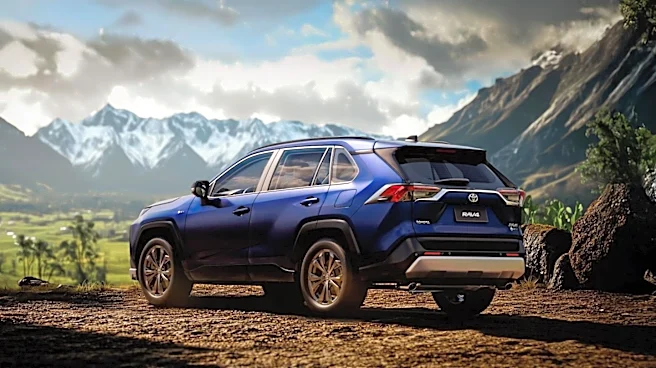
The 2026 Toyota RAV4 Woodland PHEV, a plug-in hybrid SUV, has been tested to evaluate its off-road capabilities and overall performance. While the vehicle sports a rugged, off-road-inspired design, it is
more suited for on-road driving. The Woodland trim includes features such as all-wheel drive, a blacked-out front fascia, LED fog lights, and knobby tires. Despite its appearance, the RAV4 Woodland PHEV lacks serious off-road capabilities, as it does not include underbody protection or specialized suspension. However, it excels in on-road performance, offering a smooth ride and impressive acceleration, reaching 60 mph in just 5.2 seconds. The vehicle's powertrain includes a 2.5-liter four-cylinder engine and electric motors, providing a combined output of 324 horsepower and an electric range of up to 49 miles.
Why It's Important?
The Toyota RAV4 Woodland PHEV represents a growing trend in the automotive industry where vehicles are designed to appeal to consumers seeking rugged aesthetics without compromising on-road performance. This model highlights the shift towards hybrid and electric vehicles, offering both environmental benefits and practical driving experiences. The RAV4 Woodland PHEV's ability to deliver strong performance while maintaining fuel efficiency is significant for consumers looking for versatile vehicles that can handle various driving conditions. Additionally, the vehicle's design and features cater to the increasing demand for SUVs that combine style with functionality.
What's Next?
As the automotive industry continues to evolve, manufacturers like Toyota are likely to focus on enhancing the capabilities of hybrid and electric vehicles. Future models may incorporate more advanced off-road features while maintaining the efficiency and performance seen in the RAV4 Woodland PHEV. Consumer feedback and market trends will play a crucial role in shaping the development of upcoming SUV models, potentially leading to innovations that balance rugged design with practical performance. Toyota's commitment to hybrid technology suggests that further advancements in battery life and charging infrastructure could be on the horizon.