



What's Happening?
TeraWulf Inc. (WULF) stock experienced a significant decline of 14.39%, trading at $9.34 in late-morning sessions. This drop effectively erased the gains made in the previous trading day. The immediate cause for this downturn was not a company-specific
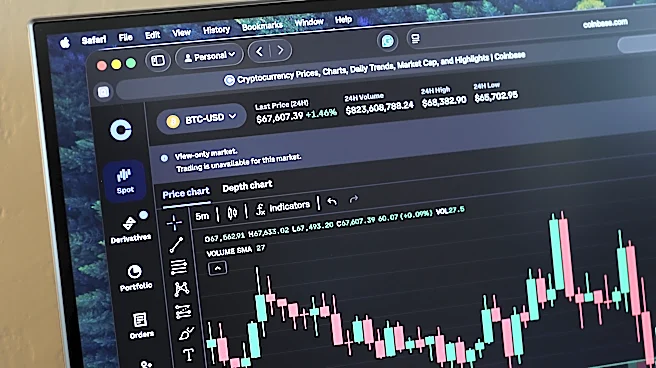
announcement but rather a broader market trend, including a widespread unwinding of the AI infrastructure trade. Additionally, bitcoin's price falling below the $60,000 mark and a strengthening dollar contributed to the pressure on TeraWulf shares. The company, which operates large-scale data centers for high-performance computing and AI workloads while also mining bitcoin, saw its stock move in line with other AI-linked equities. This sector-wide de-risking event impacted merchant GPU clouds and miner-turned-data-center landlords most severely, suggesting investor scrutiny on debt-funded capital spending for these buildouts. The decline was part of a larger trend affecting similar companies, with IREN, CIFR, NBIS, CRWV, and CORZ also experiencing notable drops.
Why It's Important?
The decline in TeraWulf's stock, alongside other AI infrastructure companies, highlights a significant shift in investor sentiment within the high-growth technology sector. This broad sell-off indicates a re-evaluation of the debt-funded capital expenditures driving the expansion of AI compute capacity. For TeraWulf, which has substantial debt exceeding $5 billion and ongoing multi-year capital programs, higher discount rates resulting from rising interest rate expectations directly impact its valuation. The company's high beta of approximately 2.65 within the AI complex makes it particularly sensitive to market fluctuations. Furthermore, bitcoin's retreat below $60,000, while a smaller portion of TeraWulf's revenue (17% of Q3 sales), still affects investor perception due to the company's historical ties to crypto mining. This market movement suggests that investors are becoming more cautious about the financing models and long-term profitability of companies heavily invested in AI infrastructure buildouts, especially those with significant leverage.
What's Next?
Investors will closely monitor several key factors that could influence TeraWulf's stock performance in the near future. The company's next financial update, expected in late February for the December quarter, will provide crucial insights into lease-up timing at its Justified and Muskie campuses in Kentucky. Management's commentary on securing a tenant for Muskie's 1,000 megawatts of contracted power will be particularly important. On the macro front, the Federal Reserve's December decision regarding interest rates, the stability of bitcoin around the $60,000 level, and the trajectory of investment-grade credit spreads for data center borrowers are critical variables. A renewed upward trend in AI-linked equities could lead to a rebound for TeraWulf, while further widening of financing costs would intensify pressure on the equity funding for its ongoing construction projects. Traders will also watch whether the $9.51 support level holds for the stock.
Beyond the Headlines
The current market dynamics affecting TeraWulf and its peers point to a deeper scrutiny of the sustainability and financing models within the rapidly expanding AI infrastructure sector. The unwinding of the 'AI infrastructure trade' suggests that the initial euphoria surrounding AI growth is giving way to more pragmatic evaluations of financial health and operational execution. This shift could lead to a consolidation within the industry, favoring companies with stronger balance sheets and more diversified revenue streams. The interplay between cryptocurrency markets and AI infrastructure companies, exemplified by TeraWulf's dual focus, also highlights the evolving nature of digital asset and high-performance computing investments. As interest rates remain a significant factor, companies reliant on substantial debt for expansion may face increased pressure, potentially leading to strategic adjustments in their growth plans or financing approaches. This period could redefine investor expectations for profitability and risk in the AI and data center sectors.