






What's Happening?
Korean Air has signed contracts totaling $44.8 billion with Boeing and GE Aerospace for the acquisition of 103 next-generation aircraft and related engine services. This significant investment includes $36.2 billion for Boeing aircraft and $8.6 billion for 21
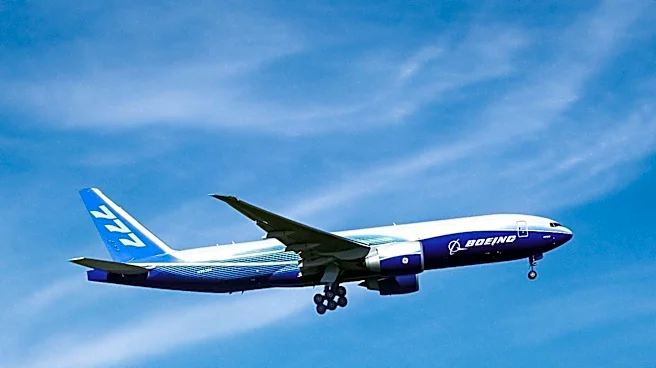
spare aircraft engines from GE Aerospace and CFM International, along with 15 years of engine maintenance services from GE Aerospace for 28 aircraft. The agreement finalizes a memorandum of understanding initially signed in Washington, D.C., last year by Hanjin Group Chairman Cho Won-tae. The new fleet will include 20 Boeing 777-9 jets, 25 787-10s, 50 737-10s, and eight 777-8F freighters. This move is part of Korean Air's strategy to modernize its fleet and enhance operational efficiency, particularly in anticipation of its merger with Asiana Airlines, scheduled for December. The large-scale purchase also aims to mitigate global aircraft delivery delays that have persisted since the COVID-19 pandemic.
Why It's Important?
This substantial deal underscores a strengthening economic and technological alliance between Korea and the United States, as highlighted by Hanjin Group Chairman Cho Won-tae. For Korean Air, the fleet modernization is crucial for its ambition to become one of the world's top 10 'mega carriers' following its merger with Asiana Airlines. The combined entity is projected to increase passenger capacity by over 55% and cargo capacity by more than 10%, significantly boosting its global competitiveness. The acquisition of next-generation, high-efficiency aircraft will allow Korean Air to optimize flight schedules, eliminate overlapping routes, and expand high-margin flights, especially from the Americas. Furthermore, by absorbing Asiana Airlines' belly cargo capacity, the merged carrier will enhance its shipping capabilities and concentrate dedicated freighters on high-yield regions, improving operational efficiency and profitability. This strategic investment positions the merged Korean Air to achieve an annual revenue target of approximately 23 trillion won and generate around 300 billion won in annual synergies.
What's Next?
The merged Korean Air is set to launch on December 17, after which the company plans to continue integrating management resources and streamlining operations to improve profitability. The introduction of the new aircraft will enable the optimization of flight schedules and the expansion of its route network, with the combined entity serving approximately 120 cities. The carrier recently secured year-round traffic rights for the Incheon-Ulaanbaatar route, indicating ongoing network expansion. The focus will be on maximizing passenger and cargo capacity, particularly by leveraging the new, more efficient aircraft. The company will also work on absorbing Asiana Airlines' operations to create a unified and more competitive global airline. The long-term success will depend on the effective integration of the two airlines and the strategic deployment of the newly acquired fleet to capitalize on global aviation market trends and demand.
Beyond the Headlines
The deal reflects a broader trend in the aviation industry where major carriers are investing heavily in fleet modernization to address environmental concerns, improve fuel efficiency, and enhance passenger experience. The acquisition of next-generation aircraft like the Boeing 777-9 and 787-10 aligns with global efforts to reduce carbon footprints and operate more sustainably. The emphasis on high-efficiency aircraft also provides a competitive edge in a market increasingly sensitive to operational costs, particularly fuel. Moreover, the strategic timing of this purchase, ahead of a major merger, highlights the importance of proactive planning in a volatile global supply chain environment, where aircraft delivery delays are common. This move could set a precedent for other airlines considering mergers or significant expansions, demonstrating the necessity of securing long-term fleet solutions to ensure future growth and market dominance. The deal also reinforces the U.S.'s role as a key supplier in the global aerospace industry.