






What's Happening?
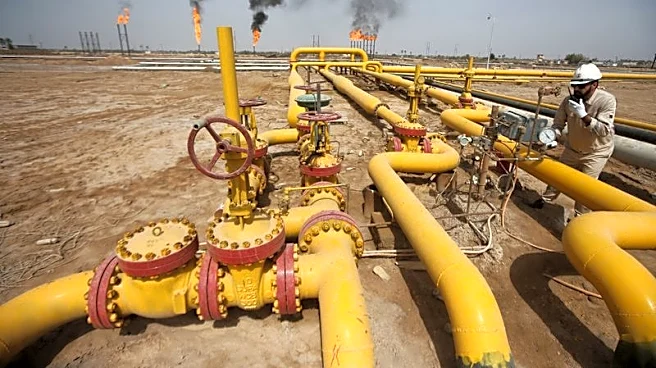
Libya is seeking to restore its position as a major global oil producer and requires significant investment, estimated at $30-40 billion, to develop its oil and gas fields. Masoud Suleman, head of Libya's National Oil Corporation (NOC), stated that a lack
of funds is hindering the development of these fields, despite the country possessing Africa's largest proven oil reserves. Several international energy companies, including Eni, TotalEnergies, Chevron, and ConocoPhillips, already operate in Libya. However, their investments have been impeded by Libya's political fragmentation, risks of corruption, and the NOC's own financial constraints. The NOC currently has to self-finance a portion of new project development costs due to insufficient state funds, leading to project delays. Consequently, the NOC is considering a return to concession agreements, where foreign investors would bear a larger share of the initial investment costs.
Why It's Important?
The challenges faced by international energy firms like ConocoPhillips in Libya highlight the significant risks and complexities associated with investing in politically unstable regions. For U.S. companies such as ConocoPhillips and Chevron, these hurdles can impact their global production portfolios and profitability. The potential for Libya to increase its oil output, if these investment barriers are overcome, could influence global oil prices and supply dynamics, affecting energy markets worldwide. However, the current political fragmentation and corruption risks in Libya deter foreign investment, limiting the country's ability to fully exploit its vast oil and gas reserves. This situation underscores the delicate balance between energy security, economic development, and geopolitical stability in resource-rich nations.
What's Next?
The NOC is exploring changes to its business model with international partners, specifically considering a return to concession agreements to attract foreign investment. This shift would aim to alleviate the financial burden on the NOC by having external investors cover a greater share of initial development costs. The success of this initiative will depend on Libya's ability to mitigate political fragmentation and corruption risks, which have historically deterred investment. NOC head Masoud Suleman indicated ongoing communication with key stakeholders across the country, suggesting efforts to build consensus and stability. However, foreign investors will still need to navigate interactions with local armed groups, adding another layer of complexity to future operations.
Beyond the Headlines
The situation in Libya extends beyond immediate investment challenges, touching upon deeper issues of national sovereignty, economic resilience, and the role of international corporations in post-conflict states. The extensive fuel smuggling problem, which Suleman described as beyond the NOC's control but requiring immediate action, poses a significant threat to Libya's economic stability. This highlights the broader governance issues and the struggle to establish effective state control over vital resources. For international energy companies, operating in such an environment involves not only financial calculations but also navigating complex ethical considerations, security risks, and contributing to, or being affected by, the host country's political and social landscape. The long-term implications could include a re-evaluation of risk assessment models for investments in volatile regions and potentially new frameworks for international cooperation in resource development.