





What's Happening?
Actors Son Ye-jin and Ji Chang-wook's teenage and twenties appearances in the Netflix series 'The Scandal' were created using Computer-Generated Imagery (CGI). This revelation came during a YouTube channel 'Netflix Korea' video featuring the lead actors.
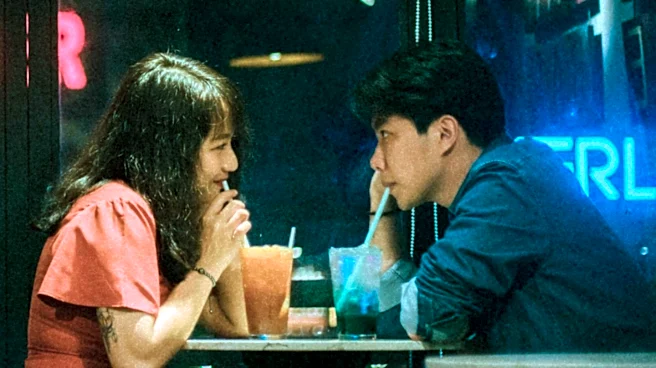
The production team confirmed that the younger versions of their characters, Jo-won (Ji Chang-wook) and Jo-yoon (Son Ye-jin), were entirely rendered with CGI. Son Ye-jin further elaborated that her actual appearances from past works, specifically her look from the film 'The Classic,' were used as a reference to create her character's youthful portrayal. Both actors expressed surprise and satisfaction with the seamless integration of the de-aging technology, noting that the CGI was so well executed it didn't appear artificial. Nana, another cast member, also expressed her unawareness of the CGI use, highlighting its effectiveness.
Why It's Important?
The successful application of de-aging CGI in 'The Scandal' signifies a growing trend and increasing sophistication in visual effects technology within the entertainment industry. This advancement allows actors to portray characters across different age ranges without the need for multiple actors or extensive makeup, maintaining continuity and enhancing storytelling. For the U.S. entertainment market, this could mean more seamless historical narratives, expanded creative possibilities for character development, and potentially longer careers for actors as age becomes less of a limiting factor for certain roles. The ability to convincingly de-age actors also raises questions about the future of casting and the authenticity of performances, as technology increasingly blurs the lines between an actor's natural appearance and their on-screen persona. This technological leap could also influence production budgets and timelines, offering new efficiencies or complexities depending on the scale of CGI implementation.
What's Next?
The effective use of de-aging technology in 'The Scandal' is likely to encourage its broader adoption in future productions, both domestically and internationally. As the technology becomes more refined and accessible, it could become a standard tool for filmmakers looking to depict characters across various life stages. This may lead to increased investment in visual effects studios and specialized talent. We might also see discussions within the industry regarding the ethical implications of altering actors' appearances, particularly concerning consent and the potential impact on body image standards. Furthermore, the success of this technology could pave the way for even more advanced digital alterations, potentially leading to entirely synthetic performances or the resurrection of deceased actors, prompting new legal and creative debates.
Beyond the Headlines
The use of CGI to recreate actors' younger selves, as seen in 'The Scandal,' delves into deeper implications concerning authenticity and the perception of reality in media. By drawing upon an actor's actual past appearances, the technology creates a hyper-realistic illusion that can be both captivating and unsettling. This raises philosophical questions about identity and representation in the digital age. For audiences, it challenges the traditional understanding of performance, where an actor's physical presence is paramount. Culturally, it reflects a societal fascination with youth and the desire to manipulate time, even if only on screen. The seamless integration of such advanced CGI could also set new benchmarks for visual effects, pushing the boundaries of what is considered achievable in filmmaking and potentially influencing other visual media forms like video games and virtual reality experiences.