







What's Happening?
A director of sacred music at St. Mary's Catholic Church and School in Temple, Texas, advocates for Black Catholic musicians to study Gregorian chant. The director, whose musical identity was shaped by Black Catholic aesthetics in Baton Rouge, Louisiana,
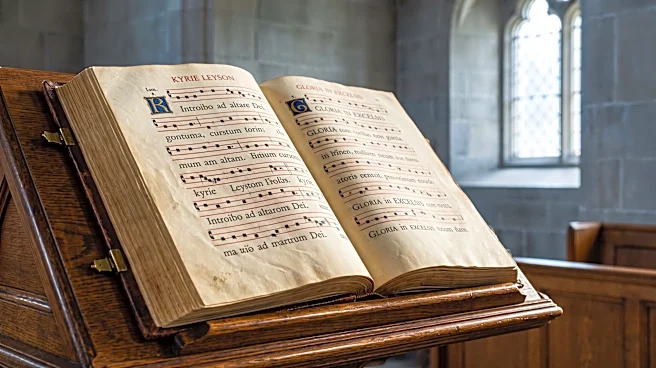
notes a gap in his formal music education regarding the foundational music of the Western church. Despite earning multiple degrees in music, he found his academic understanding of Gregorian chant to be minimal. This realization came as his current parish, a diverse community, expressed a desire for more traditional worship elements, including Gregorian chant. The parish already incorporates four-part hymnodies and prescribed antiphons, and even schoolchildren have memorized chants like Salve Regina and Regina Caeli. There is also growing interest in establishing a male Gregorian schola, highlighting the community's deep piety and wish for greater integration of chant into the liturgy. This personal and pastoral experience led the director to seek deeper study in chant, recognizing its importance for a career in Catholic church music.
Why It's Important?
The call for Black Catholic musicians to engage with Gregorian chant is significant for several reasons. It addresses a potential disconnect between contemporary Black Catholic musical traditions and the historical foundations of Catholic liturgy. By integrating chant, Black Catholic communities can enrich their worship experiences, blending their vibrant cultural expressions with the ancient musical heritage of the Church. This initiative could foster a more comprehensive understanding of Catholic sacred music among musicians who may have primarily focused on other genres. Furthermore, it supports the growing desire within some Catholic parishes for more traditional liturgical elements, promoting a broader appreciation for the diverse forms of Catholic worship. This movement could also encourage academic institutions to offer more in-depth studies of Gregorian chant, ensuring that future church musicians are well-versed in this foundational aspect of Catholic music, regardless of their cultural background.
What's Next?
The director's personal journey to study Gregorian chant, prompted by his pastor's suggestion to attend a summer course at the Catholic Institute of Sacred Music, indicates a potential path for other Black Catholic musicians. This could lead to increased enrollment in specialized programs focusing on sacred music and chant. Parishes with similar desires for traditional worship elements may look to St. Mary's Catholic Church and School as a model for integrating Gregorian chant into their liturgies. The establishment of male Gregorian scholas and the continued memorization of chants by schoolchildren could become more widespread. This trend might also encourage dioceses and Catholic educational institutions to re-evaluate their music curricula, ensuring that Gregorian chant is given adequate attention. The broader implication is a potential resurgence of interest in traditional Catholic music within diverse communities, fostering a richer and more varied liturgical landscape.
Beyond the Headlines
This development touches upon deeper cultural and theological implications within the Catholic Church in the U.S. It highlights the ongoing dialogue between cultural expression and liturgical tradition, particularly within the context of Black Catholicism, which has a rich history of integrating African American cultural forms into worship. The embrace of Gregorian chant by Black Catholic musicians can be seen as a bridge-building effort, connecting diverse communities to a shared, ancient heritage while maintaining their unique cultural identities. It challenges the notion that traditional liturgical music is exclusive to certain demographics and underscores the universal nature of Catholic worship. This movement could also spark discussions about the role of academic institutions in preparing church musicians for the diverse needs and preferences of contemporary parishes, ensuring that they are equipped with a comprehensive understanding of the Church's musical patrimony. Ultimately, it represents a step towards a more inclusive and historically informed approach to sacred music within the U.S. Catholic Church.