






What's Happening?
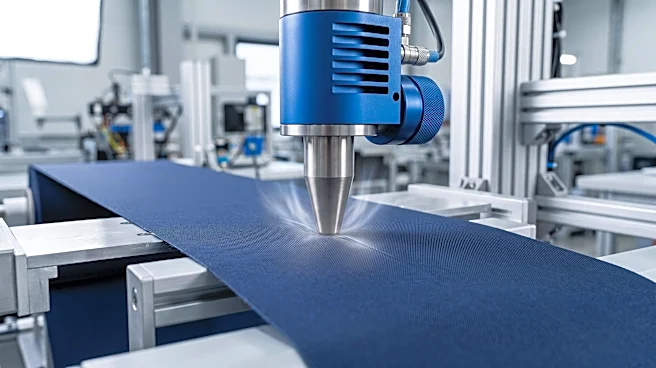
New advancements in textile manufacturing are incorporating ultrasound technology to create more recyclable synthetic fabrics. Specifically, heat-welded seams, fused with ultrasound or heat instead of traditional thread, are being used to produce mono-material
garments. These garments, such as jackets made entirely of 100% nylon, eliminate the need for separating different material components at the end of their life cycle. This 'Design for Disassembly' approach aims to simplify the recycling process by creating products that are essentially a single, pure material, making them infinitely more recyclable. This method addresses a significant challenge in synthetic fabric recycling, where mixed fibers and complex garment construction often render items unrecyclable.
Why It's Important?
The integration of ultrasound technology in textile manufacturing is a crucial step towards a more circular economy in the U.S. fashion and apparel industries. Traditional synthetic fabrics, like polyester and nylon, are derived from petroleum and contribute significantly to landfill waste and microplastic pollution. By enabling the creation of mono-material garments, this technology bypasses the complex and costly separation challenges associated with recycling blended fabrics or garments with multiple components. This innovation could lead to a substantial reduction in textile waste, decrease reliance on virgin petroleum resources, and mitigate the environmental impact of synthetic clothing, benefiting both consumers and the environment. It also presents an opportunity for U.S. manufacturers to lead in sustainable production practices.
What's Next?
The widespread adoption of ultrasound-assisted manufacturing techniques will depend on further investment in research and development, as well as industry collaboration to scale these processes. Consumers will likely see an increase in 'mono-material' labeling on clothing, indicating easier recyclability. Policy initiatives and incentives for manufacturers to adopt sustainable design principles could accelerate this transition. Furthermore, the development of robust collection and recycling infrastructure capable of handling these new mono-material textiles will be essential to realize the full environmental benefits. The success of this approach could also inspire similar innovations in other product categories facing end-of-life material separation challenges.
Beyond the Headlines
This technological shift highlights a broader movement towards 'design for sustainability,' where environmental impact is considered from a product's inception. Beyond the immediate benefits of improved recyclability, this approach could foster greater transparency in material sourcing and manufacturing processes. It also raises questions about consumer responsibility, encouraging individuals to prioritize purchasing decisions based on a product's end-of-life potential. The ethical implications extend to reducing the burden on developing nations that often bear the brunt of textile waste, and promoting a global shift away from a linear 'take-make-dispose' economic model towards one that values resource longevity and regeneration.