

What's Happening?
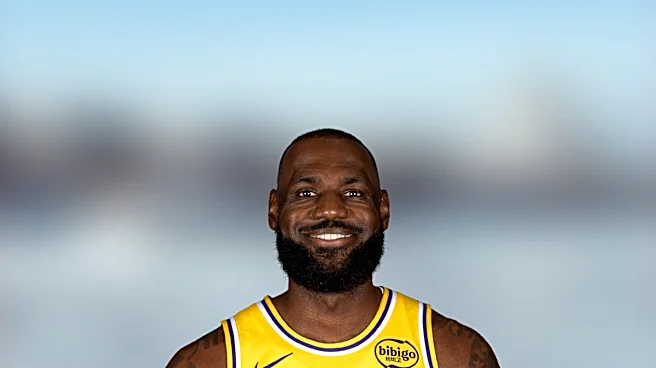
Former NBA player Kwame Brown has publicly criticized the Philadelphia 76ers, specifically commenting on recent workout videos featuring LeBron James, Jaylen Brown, and Tyrese Maxey. Brown expressed skepticism about the significance of these offseason
drills, stating that fans should not be overly excited until the regular season begins. He suggested that such workouts do not accurately reflect real-game performance, which is more physically demanding and can take a toll on players nightly. Brown's remarks imply that the current hype surrounding the 76ers, fueled by these workout videos, is premature and potentially misleading. He has a history of making controversial statements, and this latest critique has been met with suggestions of jealousy, given his own challenging NBA career. Despite his critical stance, Brown acknowledges that workouts are not equivalent to actual game action, but he dismisses the idea that players like James would struggle with soreness, arguing that James's role is to facilitate for others rather than solely score.
Why It's Important?
Kwame Brown's comments, while controversial, highlight a recurring debate in professional sports regarding the value and perception of offseason training. His critique could influence public perception of the Philadelphia 76ers, potentially dampening some of the enthusiasm generated by the high-profile workout videos. For the 76ers, managing external narratives, especially from former players, can be crucial for team morale and fan engagement. The discussion also touches on the broader media landscape in sports, where offseason content, such as workout footage, often generates significant discussion and speculation. Brown's argument that 'workouts don't hold a candle to real-life action' underscores the difference between controlled training environments and the unpredictable nature of competitive play, a perspective that resonates with some fans and analysts. This discourse can affect how teams and players choose to share their offseason preparations, balancing transparency with managing expectations.
What's Next?
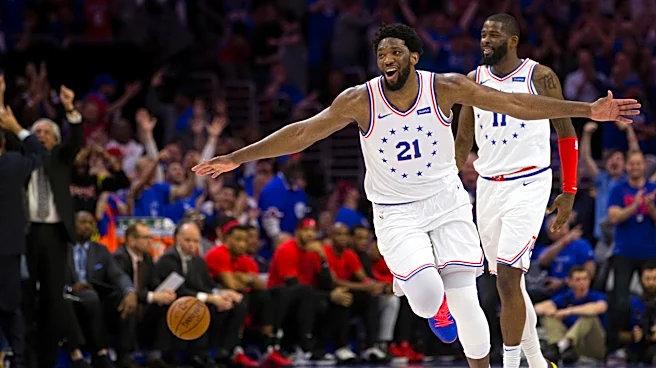
As the NBA season approaches, the Philadelphia 76ers will have the opportunity to respond to criticisms like Kwame Brown's through their on-court performance. The team's ability to integrate its star players and perform cohesively will be the ultimate determinant of whether the offseason hype was justified. Players like LeBron James, Tyrese Maxey, and Joel Embiid will be under scrutiny to demonstrate that their training has translated into effective teamwork and individual success. The media will likely continue to follow Brown's commentary, as well as other analysts' opinions, as the season progresses. If the 76ers start strong, Brown's remarks may be dismissed; however, a slow start could lend credence to his skepticism, intensifying pressure on the team. The ongoing narrative will likely focus on how the team navigates early-season challenges and whether their collective experience can overcome any rough patches, as suggested by proponents of the team.
Beyond the Headlines
The ongoing discussion sparked by Kwame Brown's comments delves into the psychological aspects of professional sports and media influence. His critique, potentially rooted in personal experiences, reflects a common sentiment among some former athletes who view current-day media hype with skepticism. This situation also highlights the evolving relationship between athletes, media, and fans, where every piece of content, even workout videos, can become a subject of intense debate. Ethically, it raises questions about the responsibility of former players when publicly critiquing current athletes, especially regarding potential impacts on team morale or individual player confidence. Culturally, it underscores the constant pressure on professional athletes to perform and the public's insatiable appetite for insights into their preparation, even if those insights are sometimes misconstrued or overhyped. The long-term implication could be a more cautious approach by teams in sharing offseason content, or conversely, a more robust defense of their training methodologies.