


What's Happening?
ARK Invest's chief futurist, Brett Winton, has released a cost model predicting that SpaceX's orbital AI compute will achieve cost parity with terrestrial data centers by 2028 and surpass SpaceX's own ground-based data centers by 2029. The model, shared
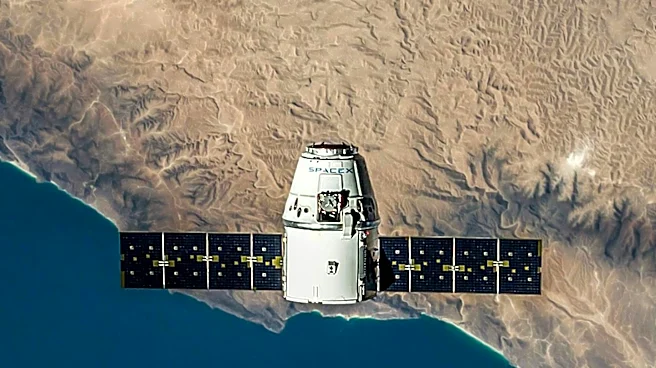
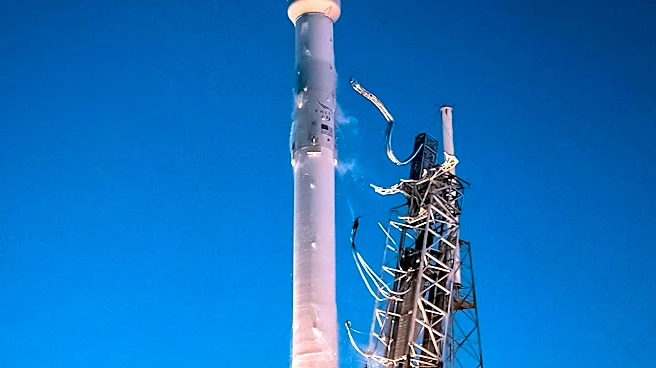
on November 24, measures the levelized cost per gigawatt-year of usable chip power. According to ARK's central case, orbital compute will cost $6.7 billion per usable IT gigawatt-year in 2030, compared to $9.7 billion for SpaceX's terrestrial sites and $14.9 billion for the industry benchmark. By 2036, these figures are projected to further diverge, with orbital compute at $4.8 billion, SpaceX's ground sites at $12.0 billion, and the industry benchmark at $18.7 billion. Key drivers for this cost reduction include rocket reuse and manufacturing gains as SpaceX scales its operations. ARK estimates that a 2027 AI satellite will carry approximately 70kW of power per tonne, increasing to 491kW by 2036, significantly reducing annual satellite capital costs.
Why It's Important?
This projection by ARK Invest highlights a potential paradigm shift in the artificial intelligence and data center industries, with significant implications for U.S. technology and infrastructure. If orbital AI compute becomes more cost-effective than terrestrial alternatives, it could lead to a reallocation of investment and development resources towards space-based solutions. This would benefit companies like SpaceX, which are at the forefront of space technology and satellite deployment. The reduced cost of AI compute could also accelerate advancements in various sectors reliant on AI, from scientific research to commercial applications, by making high-performance computing more accessible. However, the model faces skepticism from industry figures such as SemiAnalysis founder Dylan Patel and Google's head of data center energy, Amanda Peterson Corio, who question the economic viability and timeline of large-scale orbital data centers. The success of this shift hinges on continued innovation in rocket reusability and satellite manufacturing, as well as overcoming the challenges of operating data centers in space.
What's Next?
The coming years will be crucial in determining the accuracy of ARK Invest's projections. SpaceX's continued development and deployment of its Starlink satellite constellation and future AI-specific satellites will be key indicators. The company's ability to further reduce launch costs through rocket reuse and increase the power density of its satellites will directly impact the economic feasibility of orbital compute. Industry stakeholders, including chip suppliers and terrestrial data center operators, will closely monitor these developments. If orbital compute proves to be as cost-effective as predicted, it could spur increased competition and investment in space infrastructure from other companies and nations. Conversely, if the challenges highlighted by skeptics, such as high operational costs and technical hurdles, prove insurmountable in the near term, terrestrial data centers will likely maintain their dominance. The debate underscores the ongoing innovation and strategic planning within the AI and space technology sectors.
Beyond the Headlines
The potential for orbital AI compute to become more cost-effective than terrestrial options raises several deeper implications. Environmentally, space-based data centers could offer a solution to the increasing energy demands and carbon footprint of ground-based facilities, especially if powered by renewable sources in orbit. However, concerns about space debris and the environmental impact of increased rocket launches would need to be addressed. Strategically, a shift to orbital compute could enhance national security by providing resilient and geographically dispersed data processing capabilities, less vulnerable to terrestrial disruptions. Economically, it could create new markets and job opportunities in space engineering, satellite manufacturing, and orbital data management. The long-term success of this vision will depend not only on technological advancements but also on international cooperation, regulatory frameworks for space operations, and a careful consideration of the ethical implications of deploying advanced AI infrastructure beyond Earth's atmosphere.