






What's Happening?
U.S. Out-of-Home (OOH) advertising revenue experienced a significant increase, rising by 10.7% in the second quarter of 2026 to reach $3.16 billion. This marks the first time quarterly revenue for OOH advertising has surpassed the $3 billion threshold.
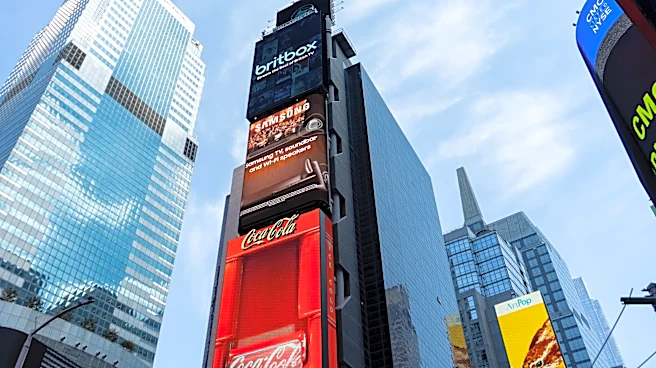
A substantial portion of this growth is attributed to Digital Out-of-Home (DOOH) advertising, which saw an 18.5% year-over-year increase and accounted for 38.4% of the total quarterly revenue. OOH advertising encompasses any advertising that reaches consumers outside their homes, including billboards, transit ads, street furniture, and place-based media. The Out of Home Advertising Association of America (OAAA) reported these figures, highlighting the channel's continued expansion. Effective OOH campaigns are characterized by simple, bold, and easily readable messages, designed for quick processing by audiences who are often in motion. The shift towards digital formats is accelerating, with programmatic DOOH ad spending projected to grow 22.6% year-over-year and reach $1.22 billion in 2026.
Why It's Important?
The surge in U.S. OOH advertising revenue underscores its enduring relevance and growing impact on the national advertising landscape. This growth, particularly in DOOH, signifies a strategic shift in how businesses are reaching consumers, moving beyond traditional digital channels to engage audiences in real-world environments. For U.S. industries, OOH offers a unique advantage: unskippable and unblockable reach, which is increasingly valuable in an era of ad-blockers and content saturation. The high recall rates, with over 80% average recall and 75% of travelers remembering digital billboards, demonstrate its effectiveness in building brand awareness and reinforcing messages. This trend benefits media owners, advertising agencies, and technology providers specializing in DOOH solutions. Furthermore, OOH's ability to drive online actions, with 66% of smartphone users taking action after seeing an OOH ad and over 40% searching for a brand online, highlights its role as a powerful complement to digital marketing strategies, influencing consumer behavior and purchasing decisions across various sectors.
What's Next?
The trajectory for OOH advertising, especially its digital component, indicates continued expansion and innovation. Programmatic DOOH is expected to see substantial growth, suggesting a future where OOH ad placements are increasingly data-driven and dynamically managed. Advertisers will likely further integrate OOH into omnichannel strategies, leveraging its ability to reinforce messages from other channels and drive online engagement. The focus will remain on creating simple, impactful visuals and messages that can be quickly processed by audiences. Measurement techniques, including location-based attribution, controlled brand studies, and attention testing using eye tracking and facial coding, will become more sophisticated to accurately assess campaign effectiveness. This will enable brands to optimize their OOH spend and ensure their creative content resonates with target audiences. The industry will also likely see more contextual DOOH campaigns, where messages adapt based on real-time conditions like weather or time of day, enhancing relevance and impact.
Beyond the Headlines
The robust growth of OOH advertising, particularly DOOH, reflects a broader societal trend of consumers spending more time outside their homes and engaging with their physical surroundings. This development has implications for urban planning and the visual landscape of U.S. cities, as digital screens become more prevalent in public spaces. Ethical considerations regarding data privacy in location-based targeting and the potential for visual clutter in urban environments may become more prominent. Culturally, OOH advertising continues to shape public perception and brand narratives, often serving as a canvas for creative expression that can become iconic. The integration of AI in creative testing and programmatic buying also signals a long-term shift towards more data-driven and automated advertising processes, potentially leading to more personalized and contextually relevant ad experiences in public spaces. This evolution challenges advertisers to balance technological advancements with creative impact and ethical responsibility.