






What's Happening?
Anthropic's S-1 filing, ahead of its upcoming initial public offering, highlights a significant strategic shift towards the life sciences sector. The company views itself as a crucial enabler for the next generation of biological and medicinal research,
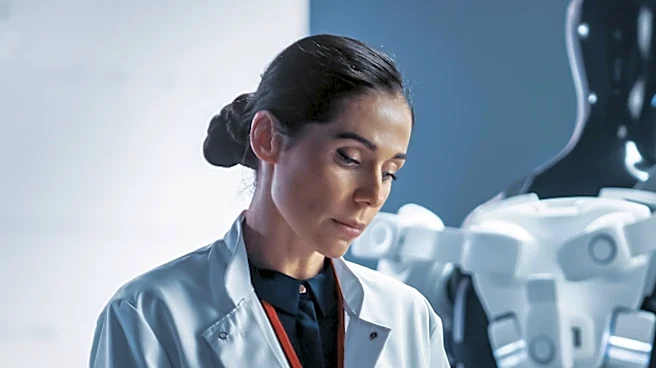
leveraging its AI capabilities. Anthropic's Claude AI is already being utilized in drug discovery and development by its customers, biotechnology partners, and internal researchers, with nine of the top ten largest pharmaceutical companies and eight of the top ten largest healthcare companies in the Fortune 500 spending at least $100,000 with Anthropic over a recent year. The company has established a molecular biology lab in the Bay Area, acquired biotech startup Coefficient Bio for $400 million in stock, and appointed Vas Narasimhan, CEO of Novartis, to its board. Anthropic also announced a new robotics standard allowing AI to control lab equipment and is actively hiring for life sciences roles.
Why It's Important?
Anthropic's aggressive entry into biotech signifies a major convergence of artificial intelligence and life sciences, potentially revolutionizing drug discovery and development. This move could lead to faster and more efficient identification of new treatments, impacting the pharmaceutical industry by accelerating research timelines and reducing costs. For U.S. industries, this means increased competition and innovation in the biotech space, with AI companies vying to become indispensable partners for pharmaceutical giants. The substantial investment and strategic partnerships indicate a belief that AI can unlock significant breakthroughs in understanding and treating diseases, potentially leading to a new era of personalized medicine and advanced therapies. This also positions Anthropic for substantial financial growth beyond its core AI software engineering tools.
What's Next?
Anthropic's IPO is expected to provide significant capital to further fuel its biotech ambitions. The company will likely continue its hiring spree for life sciences experts and expand its molecular biology research. Competition with other AI companies like OpenAI's Rosalind and Google spinoff Isomorphic Labs is anticipated to intensify as they all aim to capture market share in AI-driven drug discovery. The integration of AI with lab robotics suggests a future where AI not only designs experiments but also executes them, potentially streamlining the entire research process. The success of Anthropic's ventures could set a precedent for other AI firms to follow suit, leading to a broader AI-biotech ecosystem.
Beyond the Headlines
The deeper implications of Anthropic's biotech push extend to the ethical and societal dimensions of AI in healthcare. While the potential for curing major diseases is immense, questions around data privacy, algorithmic bias in drug development, and the accessibility of AI-driven therapies will become increasingly prominent. The long-term shift could see AI becoming an integral, rather than supplementary, component of medical research, fundamentally altering how drugs are discovered, tested, and brought to market. This convergence also raises questions about the future of human roles in scientific discovery, as AI takes on more complex tasks, potentially leading to a redefinition of scientific collaboration between humans and machines.