




What's Happening?
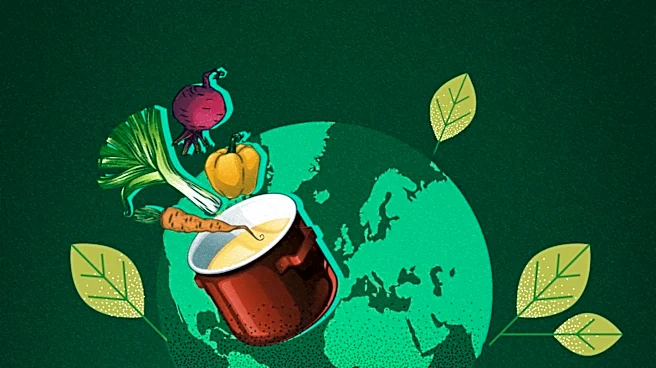
The Consumer Goods Forum’s (CGF) Food Waste Coalition has introduced the 'Value of Food Framework,' a new approach designed to help companies identify where actions across their agri-food chains can create the most business value, moving beyond traditional
food waste reduction. Historically, the focus has been on measuring and reducing food waste within a company's direct operations. However, the World Resources Institute estimates that 83% of wasted calories occur outside owned operations, with 48% on farms and 35% in homes. This framework encourages businesses to consider interventions across their entire value chain to protect supply, strengthen resilience, support commercial performance, and reduce food loss and waste. It emphasizes that reducing food waste is about protecting the inherent value of food, including its nutritional, economic, and natural resource value.
Why It's Important?
This shift in perspective is crucial for U.S. businesses and the broader food system because it addresses a fundamental challenge: the misalignment of costs and benefits in food waste interventions. Often, the cost of an intervention may fall on one actor (e.g., a grower investing in precooling), while the benefits accrue elsewhere (e.g., a retailer gaining longer shelf life). Traditional corporate metrics, which focus on internal operations, often make such value-creating interventions appear as additional expenses. The 'Value of Food Framework' aims to overcome this by providing a decision structure for companies to evaluate opportunities across their wider agri-food chain, considering financial benefits, supply-chain resilience, climate risks, regulatory readiness, and brand trust. This integrated approach can unlock significant value for businesses, consumers, and the environment, fostering more sustainable and profitable practices.
What's Next?
Companies are encouraged to begin implementing the 'Value of Food Framework' by focusing on specific products, markets, or loss points where opportunities or challenges are already apparent. This involves bringing together commercial, operational, and sustainability teams to determine effective interventions, allocate costs and benefits, and identify responsible actors. Solutions may range from internal business decisions to value chain engagement, co-investment, or risk-sharing with supply chain partners. The framework aims to transform the conversation from simply 'Where do we have food waste?' to 'Where can action across the value chain create the greatest value?' The goal is to move beyond identifying a problem to understanding the full value at stake and making informed decisions that benefit businesses, people, and the planet.
Beyond the Headlines
The 'Value of Food Framework' signifies a deeper recognition of the interconnectedness within the food system and the broader implications of food waste. Beyond economic losses, food waste represents lost raw materials, avoidable costs, supply-chain vulnerability, exposure to climate and nature risks, regulatory challenges, and lost consumer value. This framework encourages a more holistic view, highlighting ethical responsibilities towards resource stewardship and social equity by ensuring food value is preserved. Culturally, it promotes collaboration across different entities in the supply chain, fostering a shared sense of responsibility. Legally, it could influence future regulations and policies aimed at reducing food loss and waste across the entire value chain, potentially leading to more sustainable and resilient food systems in the long run.