






What's Happening?
First Solar's shares increased by 9% in premarket trading following the Democratic Party gaining control of both chambers of Congress. This surge is attributed to increased expectations for renewed federal support for clean energy policies. First Solar anticipates
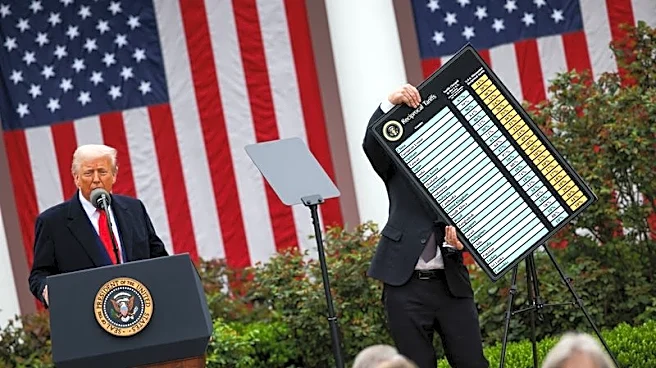
approximately $2.1 billion in federal tax credits this year for its U.S.-based solar panel production, with manufacturing subsidies protected through 2029. However, President Trump's 2025 tax law significantly reduced incentives for most new solar projects operational after 2027, though projects initiated by July 4, 2026, remain eligible. While President Trump's tariffs have benefited First Solar by imposing a price floor and duties on imported solar panels, regulatory uncertainty has led to a slowdown in new orders and a revised, lower sales forecast for the company. Democrats are expected to attempt to reinstate these incentives, but President Trump retains veto power, and the likelihood of Congress overriding a presidential veto before January 1, 2028, is estimated at 28% by Kalshi traders.
Why It's Important?
The shift in congressional control and the subsequent rise in First Solar's stock highlight the significant impact of U.S. political dynamics on the clean energy sector. The potential reinstatement of solar project incentives could stimulate solar-farm development, increasing demand for First Solar's domestically produced panels. This situation underscores the ongoing tension between policies aimed at promoting clean energy and those that prioritize domestic manufacturing through tariffs, which can also introduce market uncertainty. For investors, the volatility in solar stocks reflects the unpredictable nature of policy changes and their direct influence on company valuations and future growth prospects. The ability of Democrats to pass legislation to restore incentives will depend heavily on their capacity to overcome a potential presidential veto, indicating a period of legislative gridlock or compromise for the energy sector.
What's Next?
Democrats are expected to pursue legislation aimed at restoring incentives for new solar projects that were curtailed by President Trump's 2025 tax law. However, any such legislation would likely face a presidential veto, given President Trump's current position. The ability of Congress to override a veto is uncertain, with Kalshi traders placing the probability at 28% for any presidential veto before January 1, 2028. The market will closely watch for early bills addressing the 2025 tax law's solar provisions to gauge the Democrats' intent and the potential for legislative success. The resolution of the debate over solar tax credits is anticipated to influence the volatility of solar stocks. Additionally, the Bipartisan American Affordability and Jobs Act, which includes permitting reform for energy projects, is awaiting a Senate vote, and its outcome could also shape the energy landscape.
Beyond the Headlines
This scenario reveals the complex interplay between legislative power, executive authority, and market reactions within the U.S. energy sector. The reliance of clean energy companies like First Solar on federal incentives and tariffs exposes them to significant political risk. The debate over tax credits and tariffs also touches upon broader themes of economic nationalism versus environmental sustainability. While tariffs aim to protect domestic industries, they can also create market inefficiencies and uncertainty, as evidenced by First Solar's reduced sales forecast due to regulatory ambiguity. The long-term trajectory of the U.S. clean energy transition will depend on the ability of political actors to forge stable, bipartisan policies that balance economic competitiveness with climate goals, rather than oscillating with each change in political control.