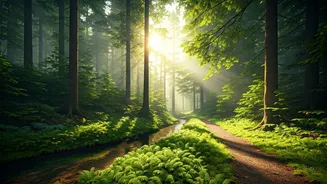







What is a Forest Holiday?
When we say ‘forest holiday’, we’re not just talking about a tent and a campfire, though that’s certainly one way to do it. This burgeoning trend encompasses a wide spectrum of experiences, from staying in luxurious eco-lodges nestled deep within a jungle
to renting a rustic cabin in the Himalayan foothills or finding a homestay on a spice plantation in the Western Ghats. The common thread is immersion. It’s about making nature the main event, not just the backdrop. Unlike a quick trip to a viewpoint, a forest holiday is about slowing down, breathing in the clean air, and attuning your senses to the rhythms of the natural world. It’s a deliberate choice to trade traffic noise for birdsong and city lights for a canopy of stars.
The Search for Space and Silence
A significant driver of this shift is a collective yearning for peace and quiet. The post-pandemic world has left many of us with a residual craving for open spaces and a desire to escape crowds. The constant connectivity and sensory overload of urban life have created a powerful counter-demand for disconnection. A forest provides a natural sanctuary from the relentless pings of notifications and the pressure to be constantly ‘on’. Travel trend reports from various platforms have noted a marked increase in searches for ‘secluded’, ‘rural’, and ‘nature-based’ properties. This isn't just about social distancing anymore; it’s about mental and emotional decompression. Travellers are actively seeking environments that offer solitude and the chance to reconnect with themselves, and the forest is the perfect setting for this introspection.
Ecotourism Goes Mainstream
The rise of the forest holiday is also intrinsically linked to a growing consciousness around sustainability. Today’s traveller is more aware than ever of their environmental footprint. They are asking questions about where their money is going and whether their holiday is contributing positively to the local ecosystem and community. Forest getaways often align perfectly with these values. Many eco-lodges and nature resorts are built on principles of sustainability, using local materials, employing local staff, promoting conservation efforts, and offering experiences that educate guests about the surrounding biodiversity. By choosing a holiday that supports a protected forest area or a community-run conservation project, travellers feel they are part of a solution, not the problem. This makes the vacation feel more meaningful and responsible.
An Antidote to Digital Fatigue
In an age of curated Instagram feeds and performative travel, the forest offers something refreshingly authentic. It doesn't require a filter. The experience is sensory and immediate—the smell of damp earth after rain, the sight of a deer at dusk, the feel of moss on a tree trunk. This authenticity is a powerful antidote to digital fatigue. A forest holiday encourages participation over observation. Instead of just taking photos, you might find yourself on a guided nature walk, learning to identify bird calls, or simply sitting on a porch, reading a book without the urge to check your phone. This desire for genuine, unscripted moments is reshaping travel preferences, pushing people towards experiences that are less about what they can post and more about what they can feel and remember.