






What's Happening?
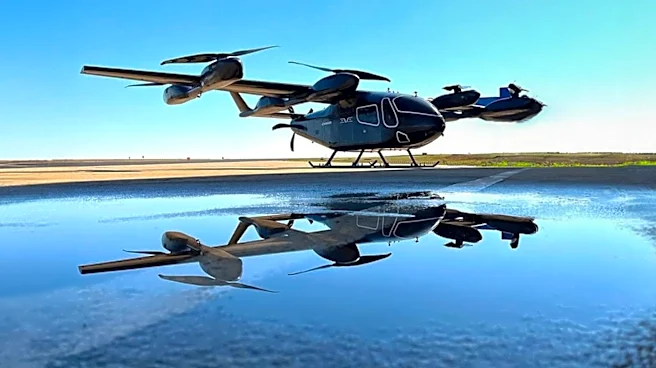
AutoFlight successfully completed a world-first formation flight involving five electric Vertical Takeoff and Landing (eVTOL) aircraft across two weight classes in Kunshan, China. The demonstrations, held on October 31 and November 1, featured a coordinated
47-minute flight with a lead V5000 Matrix covering over 133 km. The formation included one 5-ton V5000 Matrix and four 2-ton eVTOLs, comprising three different models: the V5000 Matrix, the V2000CG CarryAll cargo eVTOL, and the V2000CGF CarryAll firefighting eVTOL. The entire flight was conducted autonomously without manual intervention, maintaining stable flight and safe separation despite strong winds. This event builds upon AutoFlight's previous three-aircraft formation demonstration in May 2026.
Why It's Important?
This autonomous five-eVTOL formation flight by AutoFlight marks a significant milestone in the development of advanced air mobility. The ability to coordinate multiple eVTOLs of varying sizes and types autonomously demonstrates a crucial step towards establishing future low-altitude transport networks. This technology is essential for enabling complex operations that would be required for long-haul, regional, and last-mile routes, potentially revolutionizing cargo delivery, public services like firefighting, and eventually passenger transport. The successful demonstration of autonomous coordination under challenging weather conditions highlights the growing maturity and reliability of eVTOL technology, which could accelerate regulatory approvals and public acceptance of these aircraft. This advancement positions AutoFlight as a key player in shaping the future of urban and regional air mobility.
What's Next?
Following this successful demonstration, AutoFlight is expected to continue refining its autonomous multi-aircraft operation capabilities. The company will likely focus on expanding the complexity and duration of these flights, potentially incorporating more diverse scenarios and larger fleets. Further development will be crucial for establishing the technical foundation for future low-altitude transport networks, which will require robust and reliable autonomous systems. AutoFlight will also need to work closely with regulatory bodies to develop standards and protocols for safe and efficient multi-aircraft operations. The insights gained from these flights will inform the design and implementation of future eVTOL services, paving the way for commercial deployment of autonomous air transport solutions.
Beyond the Headlines
The successful autonomous formation flight by AutoFlight has broader implications for the future of transportation and urban planning. It suggests a future where airspaces could be managed by sophisticated AI systems coordinating numerous autonomous vehicles, leading to more efficient and potentially safer air travel. This development could also spur innovation in related fields such as AI, sensor technology, and communication systems for aerial vehicles. The use of eVTOLs for cargo and firefighting applications highlights their potential to address critical societal needs, offering rapid response capabilities and efficient logistics solutions. However, the widespread adoption of such systems will necessitate careful consideration of infrastructure development, public perception, and the ethical implications of autonomous decision-making in complex aerial environments.