



What's Happening?
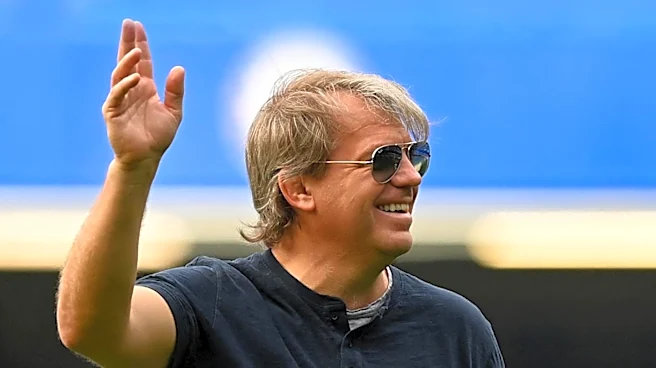
A consortium spearheaded by U.S. billionaire Todd Boehly is reportedly preparing a securities swap to acquire the international assets of sanctioned Russian oil major Lukoil. Sources close to the sales process indicate that a deal is anticipated within
weeks. A bank representing the consortium has already purchased billions of dollars worth of frozen Lukoil securities from Western investment funds. These securities, acquired at a significant discount of 30 cents on the dollar due to their sanctioned status, are intended to be exchanged for Lukoil's foreign holdings. The consortium includes Boehly, known for his stakes in Los Angeles sports teams, along with Emirati investors International Holding Company (IHC) and Al Hail Holding, the Syrian-Qatari Al-Khayat brothers, and the U.S. International Development Finance Corp (DFC). Lukoil's international assets encompass oilfields, refineries, and petrol stations across Europe, the Middle East, and Africa.
Why It's Important?
This potential acquisition holds significant implications for U.S. and international business, particularly concerning the impact of sanctions on Russian entities. If successful, the transaction would represent a major test of whether Western sanctions can compel a prominent Russian company to divest its international assets. It also highlights the complex financial maneuvers undertaken to navigate the frozen assets of sanctioned entities. For the U.S. and British investment funds that held Lukoil stock before Russia's 2022 actions in Ukraine, this deal offers a mechanism to recover some value from their previously written-down and frozen shares, albeit at a substantial discount. The involvement of the U.S. International Development Finance Corp (DFC) suggests a potential strategic interest from the U.S. government in the restructuring of these assets, possibly to limit financial gains to Moscow and ensure stability in the energy sector.
What's Next?
The deal is expected to finalize within weeks, according to the sources. Its completion would conclude a sales process that has been ongoing for over a year, initially valuing the portfolio at $22 billion, though its value has since deteriorated. The transaction will be closely watched as a precedent for how sanctioned Russian assets might be managed and transferred in the future. The consortium's ability to successfully execute this complex securities swap could pave the way for similar deals involving other sanctioned entities. Further details regarding the specific assets involved and the final terms of the exchange are anticipated as the deal progresses. The U.S. and international regulatory bodies will likely scrutinize the transaction to ensure compliance with existing sanctions regimes.
Beyond the Headlines
The proposed acquisition by the Boehly-led consortium delves into the intricate legal and ethical landscape surrounding international sanctions. The discounted purchase of frozen securities raises questions about the long-term valuation of assets held by sanctioned entities and the mechanisms available for their transfer. This situation underscores the broader economic impact of geopolitical conflicts, where financial instruments become tools for both pressure and potential recovery. The involvement of a diverse international consortium, including a U.S. billionaire and government-backed financial institutions, highlights the multifaceted approaches being taken to address the economic fallout from sanctions. It also brings to light the potential for new financial markets to emerge around distressed or sanctioned assets, creating opportunities for investors willing to navigate complex regulatory and political environments.