
What's Happening?
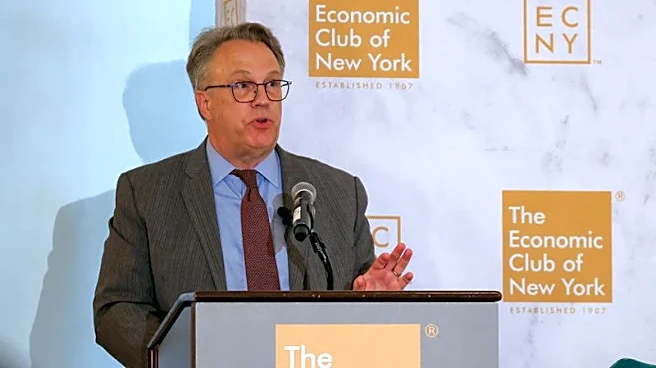
Federal Reserve Chair Kevin Warsh recently discussed three potential economic scenarios related to the development of 'super intelligence,' a term adopted by President Trump's administration for artificial
intelligence. Speaking at a conference for the Fed's Productivity and Jobs Task Force hosted by the Federal Reserve Bank of San Francisco on November 16, Warsh emphasized that these are illustrative scenarios modeled by Fed staff, not forecasts or predictions. The first scenario, considered the most optimistic, involves rising productivity with evenly shared gains between workers and capital owners, leading to above-average growth and near full employment. The second scenario, which Warsh found particularly interesting, posits that successful AI development could lead to significant labor market disruption and job displacement, even as GDP growth rises. This could push the jobless rate above full employment levels. The third scenario is a disappointment, where heavy investment in AI yields lower-than-expected returns, causing a decline in valuations and an economic slowdown before a recovery without significant productivity gains. Warsh noted that two of these scenarios are 'less positive,' with one specifically outlining a disappointing outcome for AI's economic impact.
Why It's Important?
The Federal Reserve's modeling of AI's economic impact is crucial because AI, or 'super intelligence,' is a significant driver of corporate spending and stock market gains, with potential long-term effects on growth, jobs, and inflation—key concerns managed by the Fed. The scenarios outlined by Chair Warsh highlight the complex and potentially challenging future economic landscape. If AI leads to widespread job displacement, as suggested in the second scenario, it could create a difficult situation for the Fed in balancing its dual mandate of stable prices and maximum employment. A successful AI boom that leaves a significant portion of the workforce behind could reduce consumer spending, which accounts for over two-thirds of the U.S. economy, potentially undermining the very companies that benefit from AI-driven cost savings. Conversely, a disappointing outcome for AI, as in the third scenario, could lead to a significant market correction and economic slowdown after substantial investment. These considerations are vital for investors and policymakers alike, as they underscore the need to prepare for a range of outcomes beyond the most optimistic projections.
What's Next?
While Chair Warsh stressed that these scenarios are not predictions, the fact that the Federal Reserve is actively modeling them indicates that the potential economic impacts of 'super intelligence' are a significant focus for the institution. Moving forward, the Fed will likely continue to monitor AI developments closely, refining its understanding of how these technologies could influence productivity, employment, and inflation. Policymakers may begin to consider potential monetary policy responses or regulatory frameworks that could mitigate negative outcomes, such as widespread job displacement or economic stagnation due to underperforming AI investments. Businesses and investors will also need to factor these diverse scenarios into their strategic planning, assessing the risks and opportunities associated with AI adoption and its broader economic implications. The ongoing dialogue within the Fed and among economic stakeholders will likely shape future discussions on how to harness AI's benefits while addressing its potential challenges to ensure economic stability and inclusive growth.
Beyond the Headlines
The Federal Reserve's exploration of AI's economic scenarios extends beyond immediate market reactions, touching upon fundamental shifts in the labor market and the distribution of wealth. The second scenario, where AI works too well and displaces jobs, raises profound societal questions about the future of work, income inequality, and the social safety net. It suggests a potential divergence between economic growth metrics (like GDP) and the well-being of the general populace, creating a complex challenge for policymakers. This scenario could necessitate significant re-evaluation of education systems, workforce retraining programs, and social welfare policies to adapt to a highly automated economy. Furthermore, the discussion implicitly highlights the ethical dimensions of AI development, particularly concerning its impact on human labor and societal equity. The Fed's proactive modeling indicates a recognition that technological advancements, while promising, carry inherent risks that require careful foresight and strategic planning to prevent unintended negative consequences on a national scale.