



What's Happening?
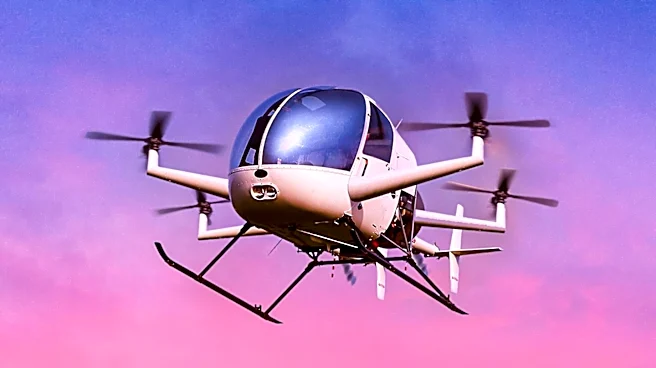
Archer Aviation is confronting significant operational challenges in scaling the production of its electric vertical takeoff and landing (eVTOL) aircraft. The company needs to establish manufacturing facilities capable of producing airframes, battery
systems, and propulsion components at a commercial pace, moving beyond prototype volumes. A central priority is securing dependable supply chains for specialized batteries, motors, and composite materials. Beyond aircraft manufacturing, Archer Aviation is also focusing on developing ground infrastructure, including vertiports, charging stations, and air-traffic integration systems, which are crucial for commercial eVTOL service. The company recently completed a piloted flight of its Midnight aircraft between two California communities, coordinated with federal aviation regulators, as part of its certification efforts. Additionally, Archer Aviation has expanded its scope through an arrangement with Boeing, incorporating autonomous aviation and unmanned systems businesses, and developing an AI-powered software platform called Zee to support flight operations and airspace management.
Why It's Important?
The challenges faced by Archer Aviation highlight broader issues within the emerging eVTOL sector, impacting the future of urban air mobility in the U.S. and globally. The capital-intensive nature of parallel aircraft development and manufacturing scale-up, coupled with the extended timeline for civil aviation certification, poses substantial financial and operational risks for companies in this space. The need to build entirely new categories of ground infrastructure, such as vertiports in dense urban environments, requires significant investment and coordinated development with local authorities and partners. Successful navigation of these hurdles by companies like Archer Aviation is critical for the widespread adoption of eVTOL technology, which promises to revolutionize short-distance urban and regional air transportation by reducing congestion and offering faster travel times. The integration of defense-adjacent technologies and AI software also indicates a strategic diversification that could provide alternative revenue streams and accelerate technological advancements applicable to both commercial and defense sectors.
What's Next?
Archer Aviation will continue to advance its flight-test program for the Midnight aircraft to achieve full civil certification, a key regulatory milestone for commercial passenger service. Simultaneously, the company will focus on scaling its manufacturing capacity to support eventual commercial production volumes. The integration of newly acquired unmanned systems and software businesses from Boeing will be an additional operational priority, requiring coordination across engineering and program teams. Further development of vertiport and ground-infrastructure partnerships will also be crucial, as commercial passenger service depends on a coordinated build-out of charging, maintenance, and passenger-handling facilities. The company's ongoing development of the Zee aviation software platform will aim to demonstrate practical applications for airspace and airport-movement modeling, which are essential for safe and efficient eVTOL operations. The broader market will be watching for continued progress in certification, manufacturing, and infrastructure development as indicators of the sector's viability.
Beyond the Headlines
The efforts by Archer Aviation and other eVTOL developers to overcome production and infrastructure challenges extend beyond mere technological innovation; they represent a fundamental shift in urban planning and transportation paradigms. The successful deployment of eVTOLs will necessitate significant regulatory evolution, requiring federal aviation regulators to adapt existing frameworks for an entirely new class of aircraft and operational procedures. Ethical considerations regarding noise pollution, visual impact, and equitable access to urban air mobility services will also become increasingly prominent. Furthermore, the integration of AI and autonomous flight software raises complex questions about safety, cybersecurity, and the future role of human pilots. The diversification into defense-adjacent technologies could also blur the lines between civilian and military applications, potentially influencing public perception and regulatory oversight. The long-term success of urban air mobility hinges not just on the aircraft themselves, but on a holistic transformation of urban infrastructure, regulatory landscapes, and societal acceptance.