







What's Happening?
The Shanghai Cooperation Organization (SCO) is increasingly focusing on connectivity and economic cooperation, a development that aligns with Azerbaijan's strategic interests. Azerbaijan, a partner with the SCO, is positioned as a crucial link in the Middle
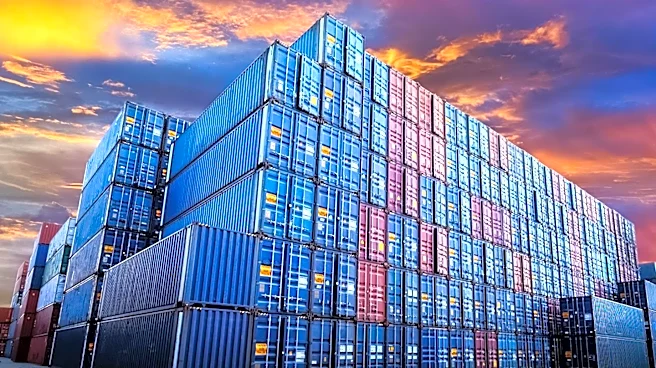
Corridor, also known as the Trans-Caspian International Transport Route. This corridor connects China and Central Asia with the South Caucasus, Turkey, and European markets via the Caspian Sea. The importance of the Middle Corridor has grown significantly as Eurasian businesses and governments seek efficient and reliable transportation links. Azerbaijan has invested heavily in its transportation infrastructure, including the Port of Alat, the Baku-Tbilisi-Kars railway, highways, and airports, to support international transit. Official figures indicate that cargo traffic through the Middle Corridor via Azerbaijan has increased by approximately 90 percent since 2022, with plans to expand the Port of Alat's capacity from 15 million to 25 million tons annually.
Why It's Important?
Azerbaijan's enhanced partnership with the SCO and its pivotal role in the Middle Corridor are significant for global trade and geopolitical dynamics. The Middle Corridor offers an alternative to traditional sea routes and other land corridors, potentially diversifying global supply chains and reducing reliance on specific choke points. For the U.S. and its allies, the development of this corridor could impact existing trade relationships and geopolitical influence in Eurasia. Increased connectivity and economic cooperation within the SCO, facilitated by Azerbaijan, could strengthen economic ties among member states and partners, potentially leading to new trade blocs and shifts in global economic power. The success of the Middle Corridor hinges on international cooperation, harmonized customs procedures, and integrated logistics, which could set new standards for cross-border trade efficiency. This evolving landscape presents both opportunities for new markets and challenges to established trade routes and economic partnerships, influencing U.S. commercial and strategic interests in the region.
What's Next?
The future success of the Middle Corridor will depend on continued cooperation across its entire route, involving countries like China, Central Asia, the South Caucasus, Turkey, and European markets. Azerbaijan's role is expected to evolve beyond a mere transit country to a logistics platform, linking various economic regions. The SCO's growing emphasis on economic cooperation is anticipated to create a platform for complementary connectivity projects, trade facilitation, and infrastructure development. Digitalization and coordination of customs procedures, electronic documentation, and predictable tariffs will be crucial for the corridor's commercial competitiveness. Greater integration among Central Asian markets is also expected to increase cargo volumes reaching the Caspian and Azerbaijan. The long-term significance of the Middle Corridor will be measured by its commercial performance, including cargo capacity, speed of goods movement, predictability, and economic attractiveness for businesses. This ongoing development will likely reshape Eurasian trade patterns and influence global logistics strategies.
Beyond the Headlines
The rise of the Middle Corridor, bolstered by Azerbaijan's strategic investments and SCO partnership, represents a broader geopolitical reorientation of trade and influence. This shift could diminish the strategic importance of traditional maritime routes and certain land-based corridors, potentially altering naval power projections and regional security dynamics. The emphasis on digitalizing customs and harmonizing procedures within the corridor highlights a move towards 'smart logistics,' which could become a model for future international trade infrastructure, reducing bureaucratic hurdles and increasing efficiency. However, the success of such a complex, multi-national project also raises questions about data governance, cybersecurity, and the potential for geopolitical rivalries to disrupt its smooth operation. The Middle Corridor's development could also foster greater economic interdependence among participating nations, potentially leading to new forms of regional integration and cooperation that extend beyond purely economic considerations, influencing cultural exchange and political alignment in Eurasia.