




What's Happening?
Airbility, a deep-tech aerospace and defense company specializing in high-speed electric vertical takeoff and landing (eVTOL) aircraft, has successfully secured USD 4.7 million (KRW 6.5 billion) in Series A funding. This round was led by Silicon Valley-based
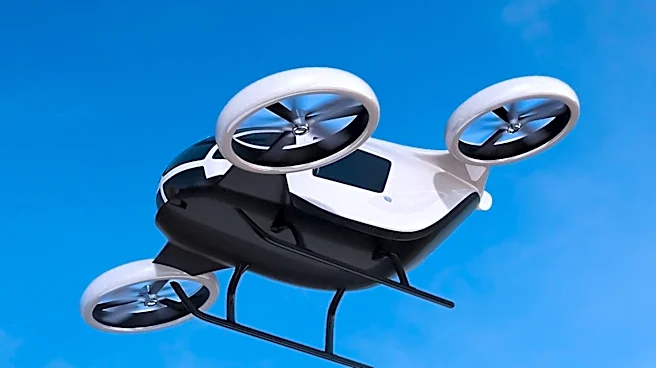
global VC Sazze Partners, bringing Airbility's total funding to USD 7.6 million (KRW 10.5 billion). The company plans to utilize these funds to advance its end-to-end counter-unmanned aircraft system (counter-UAS) portfolio, which is designed to physically neutralize hostile drones in the air. A significant portion of the investment will be allocated to establishing the necessary production infrastructure to scale manufacturing. Airbility's counter-UAS architecture integrates airborne interceptors with onboard autonomy and external sensing assets, built around its high-speed eVTOL platforms. The company aims to commercialize its AB-U10 net-gun-equipped interceptor by the end of 2026 and introduce two new interceptors, the AB-U2 and AB-U4L, in the first half of 2027, with the AB-U60 mothership platform targeted for launch in 2027.
Why It's Important?
This funding is crucial for Airbility as it addresses a significant and growing challenge in drone defense: the cost asymmetry between offensive and defensive measures. The company estimates its air-to-air approach can reduce the cost of an engagement to approximately USD 50 to USD 3,000, a stark contrast to the estimated USD 4 million cost of a Patriot interceptor against a USD 35,000 Shahed-type drone. By developing domestically produced eVTOL counter-UAS systems, Airbility aims to offer a more affordable and flexible solution, particularly for export customers who face origin restrictions and lengthy procurement processes for comparable overseas systems. The establishment of robust production infrastructure will enable Airbility to meet anticipated global demand, potentially positioning it as a key player in the defense technology sector and enhancing national security capabilities against drone threats.
What's Next?
Airbility plans to accelerate the commercialization of its integrated, high-speed eVTOL counter-UAS portfolio. The company intends to launch its first counter-UAS aircraft this year and establish a three-interceptor lineup by the first half of next year. In parallel, Airbility will enhance the onboard AI powering its interceptors to enable independent mission execution in communications-limited environments and integrate with external detection assets for a coordinated system. The company is also strengthening its manufacturing system, leveraging in-house capabilities in 3D printing, composite airframes, battery packs, and flight-control software. Airbility is actively engaged in commercial discussions with potential partners in over nine countries across the Middle East, Southeast Asia, and Latin America, with four memoranda of understanding and two joint-venture initiatives currently in progress. The company aims to achieve KRW 50 billion in cumulative revenue by 2028.
Beyond the Headlines
The development of advanced eVTOL counter-UAS systems like Airbility's signifies a broader shift in modern warfare and defense strategies. The increasing proliferation of affordable and sophisticated drones by both state and non-state actors has created a pressing need for cost-effective and agile countermeasures. Airbility's focus on reducing the cost of engagement could democratize drone defense, making it accessible to a wider range of nations and potentially altering the strategic balance in regional conflicts. Furthermore, the integration of AI for autonomous mission execution highlights the growing reliance on artificial intelligence in defense applications, raising ethical considerations regarding autonomous weapon systems and the future of human-in-the-loop decision-making in combat. The company's emphasis on exportability also suggests a potential for significant geopolitical impact, as advanced drone defense technology becomes more widely available.