



What's Happening?
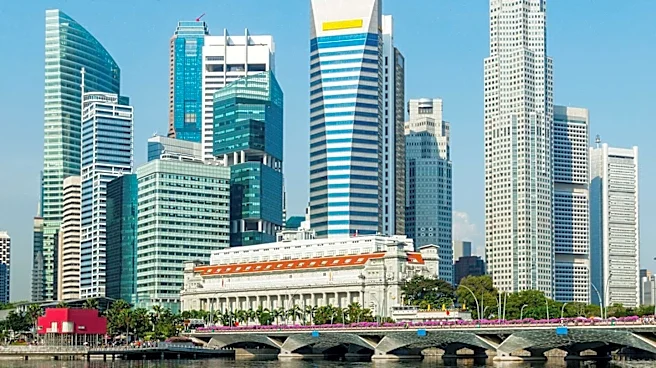
Mistral AI, a French artificial intelligence company, has selected Singapore as its Asia-Pacific headquarters. This strategic move, reported by Fortune on November 20, 2026, includes plans to double its regional workforce to 200 employees by 2027. The
new office will also function as an extended 'Science Hub,' focusing on advanced AI models tailored for the region's public sector, high-tech manufacturing, and robotics industries. Marjorie Janiewicz, Mistral AI's chief revenue officer, emphasized the company's role in offering global companies an alternative for achieving autonomy and business continuity from their AI suppliers. The company's engagement in Singapore began with outreach from the Ministry of Defence in 2024. Since then, Mistral AI has secured an agreement with HTX, a statutory board under Singapore's Ministry of Home Affairs, to collaborate on video AI, embodied AI, and AI for cybersecurity. Additionally, Singtel's sovereign AI cloud unit, RE:AI, has committed to co-developing AI infrastructure with Mistral AI.
Why It's Important?
Mistral AI's expansion into Singapore signifies a growing competition in the Asia-Pacific AI market, particularly against established Chinese open-weight models. The company aims to differentiate itself by offering hands-on support to integrate AI projects into production, with over 70% of its regional team comprising 'forward deployed engineers and scientists,' according to Geoff Soon, Mistral's vice president of revenue for Asia-Pacific. This approach could provide a significant advantage in a market where local entities, such as Singapore's national AI program, have previously utilized models built on platforms like Alibaba's Qwen. The focus on public sector, high-tech manufacturing, and robotics indicates Mistral AI's intent to capture critical segments of the regional economy, potentially influencing the adoption of European AI technologies over alternatives. The partnerships with Singaporean government bodies and telecommunications firms underscore the strategic importance of this move for both Mistral AI and the region's technological development.
What's Next?
Mistral AI is set to significantly increase its regional staff to 200 by 2027, indicating a substantial investment in human capital and operational capacity in Singapore. The company's 'Science Hub' will continue to develop frontier models specifically for the Asia-Pacific public sector, high-tech manufacturing, and robotics, suggesting a pipeline of new AI solutions tailored to regional needs. The ongoing collaborations with HTX on video AI, embodied AI, and cybersecurity, as well as with Singtel's RE:AI for co-developing AI infrastructure, are expected to yield tangible results in these critical areas. This regional expansion follows recent financial backing, including a 100 million euro investment from Deutsche Telekom, which will likely fuel further growth and development. While an IPO is not planned for the current year, CEO Arthur Mensch has indicated that Europe is the natural location for a future public offering, suggesting a long-term strategic vision for the company's global presence and financial trajectory.
Beyond the Headlines
Mistral AI's emphasis on 'autonomy' and 'sovereignty' in AI solutions highlights a broader global trend where nations and organizations are seeking greater control over their technological infrastructure and data. This push for independent AI capabilities, particularly in critical sectors like defense and cybersecurity, reflects concerns about data privacy, national security, and the potential influence of foreign AI providers. By positioning itself as an alternative to Chinese models and offering hands-on support, Mistral AI is tapping into a demand for trusted and transparent AI partnerships. This strategic move could also foster greater collaboration between European and Asian technology ecosystems, potentially leading to the development of new international standards and ethical frameworks for AI. The establishment of a 'Science Hub' in Singapore further solidifies the city-state's role as a key innovation hub in Asia, attracting top AI talent and fostering a dynamic environment for advanced technological research and development.