



What's Happening?
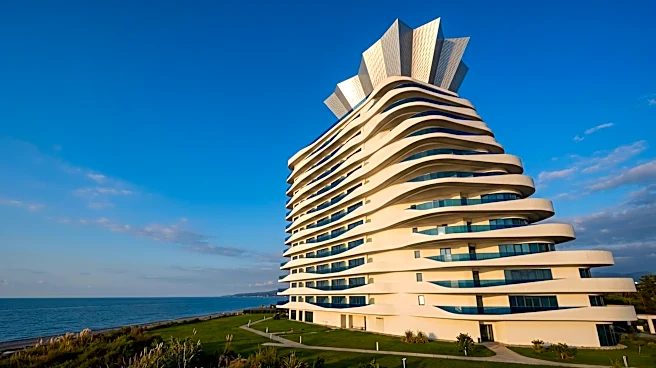
A new residential complex named Montemar Residential, located on Georgia’s Adjara coast, is challenging conventional architectural norms by rejecting straight lines in its floor plan and overall design. Designed by Irakli Emiridze and Irina Chkonia of
Alpha Architecture, the three-tower complex in the seaside town of Gonio features forms that ripple, curve, and cantilever, drawing inspiration from the Black Sea. Each of the 16-story towers, ranging from 48 to 52 meters in height, is topped with a dramatic aluminum crown that flares out, resembling a mushroom cap or an opening seashell. The facade's balcony edges undulate, staggering in and out like sediment ridges carved by tidal movement, giving the towers a geological texture rather than a typical grid. Aluminum embossed sheet cladding wraps the crowning terraces, providing a unique light-catching quality. The 10,000 square meter plot includes underground parking for 300 vehicles, leaving the ground level free for landscaping, plazas, and communal zones designed to encourage resident interaction. Panoramic apartments offer private terraces and jacuzzis angled towards the water, a feature typically reserved for penthouses but now standard in this development.
Why It's Important?
This architectural project signifies a notable shift in industrial design and urban development, particularly in coastal regions. By moving away from conventional, cost-effective straight-line construction, Montemar Residential highlights a growing demand for unique, aesthetically driven, and environmentally integrated designs. This approach could influence future residential and commercial developments in the U.S., especially in areas with significant natural landscapes or waterfronts, where developers might seek to differentiate their projects through innovative design. The emphasis on organic forms and public spaces within the complex reflects a broader trend towards creating more livable and visually appealing urban environments. The project's location within a UNESCO-listed coastline also underscores the increasing importance of harmonizing modern architecture with natural and historical contexts. For the U.S. construction and real estate industries, this could mean a greater focus on bespoke designs, higher investment in architectural innovation, and a potential increase in demand for specialized design and engineering services capable of executing complex, non-linear structures. It also suggests a market for luxury developments that prioritize unique aesthetics and integrated amenities, moving beyond standard high-rise models.
What's Next?
The completion and public reception of Montemar Residential will be a critical test of whether sculptural ambition can coexist successfully with UNESCO designations and attract buyers in a non-resort capital. If the finished towers live up to the promises of the renderings, this project could serve as a case study for future developments seeking to integrate organic architectural forms into sensitive environmental or historical sites. Its success might encourage other developers and architects globally, including in the U.S., to adopt similar design philosophies, prioritizing aesthetic integration with nature over purely functional or cost-driven construction. This could lead to a greater emphasis on sustainable and context-sensitive design practices in urban planning. Furthermore, the project's innovative use of materials like aluminum embossed sheet cladding could inspire new material applications in construction. The democratization of luxury amenities, such as private terraces and jacuzzis, could also become a more widespread trend in competitive real estate markets, pushing developers to offer more high-end features as standard to attract buyers. The project's impact on the local Gonio area will also be observed, particularly how it balances increased tourism or residency with the preservation of its historic and natural character.
Beyond the Headlines
Montemar Residential's design philosophy delves into deeper implications regarding the relationship between human-made structures and the natural world. By mimicking the ocean's curves, the architecture challenges the traditional human imposition of rigid geometry onto landscapes, instead seeking a more symbiotic relationship. This approach can be seen as a response to a growing cultural desire for environments that feel less artificial and more connected to nature, even within urban settings. Ethically, it raises questions about responsible development in ecologically sensitive areas, particularly UNESCO sites, and how modern architecture can contribute to, rather than detract from, natural beauty. The project also highlights the evolving definition of luxury in real estate, moving beyond sheer size or opulence to encompass unique design, environmental integration, and a sense of place. Culturally, it reflects a global trend towards valuing bespoke, artistic expression in architecture, where buildings are seen not just as functional spaces but as works of art that contribute to the identity of a location. This shift could foster a greater appreciation for architectural innovation and push the boundaries of what is considered possible or desirable in contemporary building design, influencing aesthetic preferences and design education worldwide.