





What's Happening?
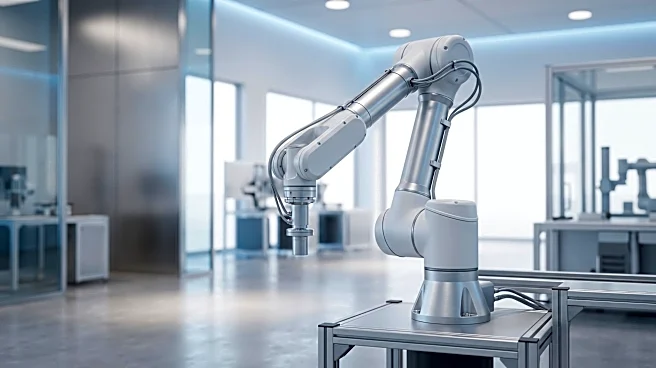
Universal Robots, a global leader in collaborative industrial robots (cobots), has introduced its seventh-generation robotics platform, Gen 7, at the IMTS tradeshow in Chicago. This new platform is designed to be 'out-of-the-box AI-ready,' providing companies
with advanced software tools and enhanced connectivity to integrate AI into industrial operations. Gen 7 features a completely reengineered control box, teach pendant, and tool flange, all anchored by the PolyScope X robot operating system. Key innovations include new g-Series robot arms with AI-ready tool flanges that enable real-time vision and sensing for AI models, a CB7 Core controller with increased compute power, and a lighter, more ergonomic TP7 Core teach pendant. The platform also emphasizes safety and cybersecurity, with PLd, Category 3 (ISO 13849-1) certified architecture and IEC 62443-4-1 ML3 cybersecurity certification.
Why It's Important?
The launch of Universal Robots' Gen 7 platform marks a significant advancement in industrial automation and the practical application of physical AI. By making AI integration more accessible and less complex, this technology can revolutionize manufacturing processes across various U.S. industries. Companies can expect increased efficiency, precision, and flexibility in tasks such as dexterous manipulation and force-sensitive assembly. This development is crucial for maintaining competitiveness in a global market, as it allows U.S. businesses to leverage cutting-edge robotics to optimize production, reduce operational costs, and innovate product development. The emphasis on safety and cybersecurity also addresses critical concerns for industrial adoption, fostering trust and enabling broader deployment of AI-powered cobots in sensitive environments. This could lead to job displacement in some areas but also create new high-skilled jobs in robotics programming, maintenance, and AI development.
What's Next?
The immediate next steps involve the widespread adoption and integration of the Gen 7 platform into various industrial settings. Universal Robots is showcasing the platform with over 20 ecosystem partners at IMTS, demonstrating its functionality with leading machine vision and gripping providers. This collaborative approach, supported by the UR+ ecosystem, aims to de-risk integration for customers and accelerate deployment. Over time, the capabilities of Gen 7 are expected to expand as developers leverage its open APIs and ROS2 communication to build more sophisticated edge-AI applications. This will likely lead to a proliferation of AI-powered solutions in manufacturing, logistics, and other sectors, driving further automation and potentially reshaping the industrial workforce. Training and upskilling initiatives will become increasingly important to prepare the workforce for these advanced robotic systems.
Beyond the Headlines
The introduction of the Gen 7 platform signifies a deeper trend towards the 'physical AI revolution,' where intelligent machines interact with and manipulate the physical world with increasing autonomy and sophistication. This development has profound implications beyond mere industrial efficiency, touching upon the future of work, human-robot collaboration, and the ethical considerations of AI in physical environments. The ability of cobots to perform complex tasks with human-like dexterity could lead to new forms of manufacturing and service industries, potentially blurring the lines between human and machine labor. Furthermore, the platform's focus on cybersecurity highlights the growing importance of securing interconnected industrial systems from cyber threats, a critical concern for national infrastructure and economic stability. This evolution will necessitate ongoing dialogue about the societal impact of advanced robotics and the need for responsible innovation.