
What's Happening?
Renowned German-American director Werner Herzog has expressed strong disapproval of applying terms like 'neurodivergence' and 'ADHD' to his film characters. Speaking at the Venice Film Festival, Herzog stated
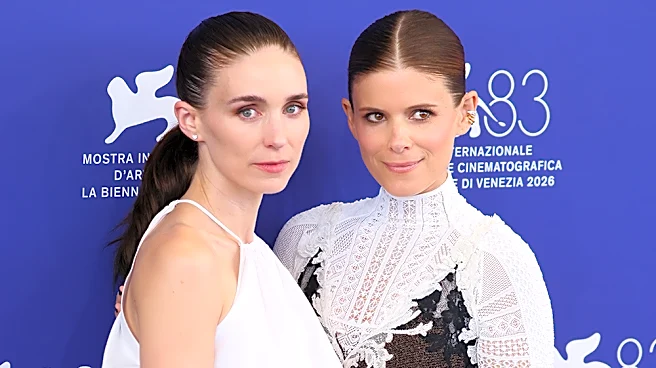
that such terminology 'sounds like political correctness, which scares me under the table.' He believes these modern labels imply a 'clinical aberration,' whereas he views his characters, such as the Holbrooke sisters in his new film 'Bucking Fastard,' as 'dead center' in their unique perspectives. Herzog's latest feature, his first non-documentary in 17 years, stars real-life sisters Kate and Rooney Mara as siblings who share a singular obsession, including a quest to dig a tunnel connecting a cave in County Sligo to the Orkneys. Despite potential interpretations of their behavior as consistent with autism or ADHD hyper-focus, Herzog dismisses these contemporary psychiatric terms, asserting they 'dust out of my ears.' He maintains that his characters are simply single-minded outsiders, a recurring theme in his extensive filmography.
Why It's Important?
Herzog's stance highlights a broader cultural debate regarding the medicalization and labeling of unique human behaviors and personalities, particularly within the arts. His rejection of terms like 'neurodivergence' reflects a perspective that values individual eccentricity and intense focus as inherent aspects of character, rather than as clinical conditions. This viewpoint challenges the increasing trend in society to categorize and diagnose behaviors, suggesting that such labels might diminish the artistic and humanistic understanding of complex individuals. For the film industry and audiences, Herzog's comments encourage a more nuanced appreciation of character development, urging viewers to see his protagonists as distinct personalities driven by their own internal logic, rather than as representations of diagnostic categories. This perspective could influence how filmmakers approach character creation and how critics and audiences interpret them, fostering a discussion about the balance between clinical understanding and artistic freedom in portraying human experience.
Beyond the Headlines
Herzog's comments delve into the philosophical implications of language and its power to shape perception. By dismissing 'neurodivergence' as 'political correctness,' he touches upon a concern that the proliferation of diagnostic labels can inadvertently pathologize human diversity, potentially stifling the appreciation of unconventional thought and behavior. This raises questions about whether an overreliance on clinical terminology might lead to a reductionist view of human nature, where unique traits are seen as deviations from a norm rather than as variations within the spectrum of human experience. His preference for describing characters as 'single-minded outsiders' or 'dead center' suggests an artistic commitment to portraying individuals in their full, unclassified complexity. This perspective invites a deeper consideration of how society defines 'normal' and 'abnormal,' and whether the language used to describe mental states can inadvertently limit our understanding and acceptance of human individuality, particularly in creative and artistic contexts.