


What's Happening?
Cornish Lithium, a British mineral company, has contracted Halliburton, a Texas-based oilfield services company, to drill two wells in Cornwall, England. The project aims to assess the concentration of lithium dissolved in hot water circulating beneath
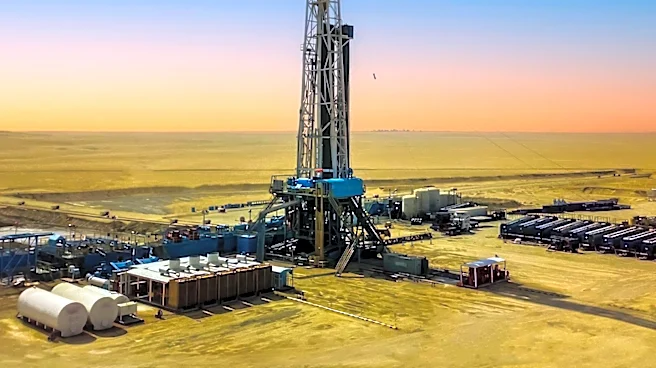
the company's Cross Lanes site. The plan involves drilling two wells, each approximately 6,560 feet deep, from a single pad. One well will extract brine to the surface, while the other will reinject the stripped water back into the ground after lithium ions are extracted using a direct lithium extraction (DLE) process. This method avoids open-pit mining and large evaporation ponds. Halliburton's role includes subsurface modeling, well engineering, and providing equipment and services for drilling and testing. The drilling and testing program is budgeted at £14.5 million (approximately $19.6 million), with half funded by a UK government grant and the other half matched by Cornish Lithium.
Why It's Important?
This collaboration highlights a growing trend of leveraging traditional oilfield expertise for geothermal lithium extraction, a critical component for electric vehicle batteries. For the U.S. industry, it demonstrates the potential for American companies like Halliburton to expand their services into the burgeoning clean energy sector globally. The DLE process, if proven commercially viable at scale, could offer a more environmentally friendly alternative to conventional lithium mining, reducing the ecological footprint of battery production. The project's success could also influence investment in similar geothermal lithium projects in the U.S., particularly in regions with suitable geological formations like the Smackover Formation in Arkansas and East Texas. The ability to accurately quantify lithium reserves through such drilling is crucial for securing financing and establishing a reliable domestic supply chain for battery materials, reducing reliance on foreign sources.
What's Next?
The drilling and testing program is expected to commence soon, with three months of flow testing planned once both wells are completed. The data collected from these tests will be crucial for Cornish Lithium to determine the commercial viability of the Cross Lanes site and make a final investment decision. If the water tests reveal higher lithium concentrations than previously found, Cornish Lithium plans to develop a network of modular geothermal lithium hubs across Cornwall, potentially also providing geothermal heat for local communities. The project's outcome will be closely watched by the global lithium industry and could pave the way for similar partnerships between oilfield service companies and mineral exploration firms in other regions, including the U.S., as the demand for battery-grade lithium continues to surge.
Beyond the Headlines
The engagement of an oilfield services giant like Halliburton in a geothermal lithium project underscores a significant convergence between the traditional energy sector and the renewable energy transition. This crossover reflects the adaptability of existing drilling technologies and expertise to new resource extraction challenges. It also highlights the strategic importance of lithium as a critical mineral, driving innovation in extraction methods to meet global demand. The DLE process, by minimizing environmental impact, could set new standards for sustainable resource extraction, potentially influencing regulatory frameworks and public perception of mining operations worldwide. Furthermore, the project's success could bolster the UK's efforts to establish a domestic lithium supply chain, reducing its dependence on imports and strengthening its position in the global EV market, a model that other nations, including the U.S., are keen to emulate for national security and economic reasons.