


What's Happening?
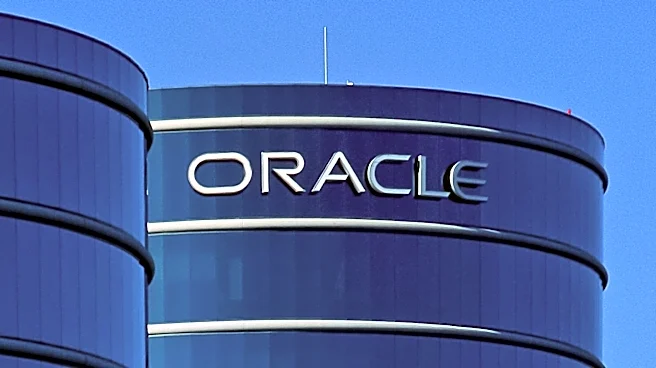
Oracle Corporation (NYSE: ORCL) experienced a 5.5% drop in its stock price, closing around $135.69, following reports that clarified OpenAI's actual annualized recurring revenue (ARR). Previously, Wall Street had estimated OpenAI's revenue run-rate to be
between $68 billion and $70 billion. However, a report by the Financial Times indicated that OpenAI's net annualized run-rate is closer to $50 billion. This downward adjustment in revenue expectations for a major cloud customer has put pressure on Oracle, which has significantly invested in AI infrastructure. The company's long-term debt has surpassed $160 billion, contributing to valuation concerns. Operational challenges, such as power-supply and infrastructure constraints at data centers, are also hindering Oracle's ability to convert its backlog into revenue-generating compute capacity. The sell-off also affected other AI infrastructure players, including Nvidia, Broadcom, and CoreWeave.
Why It's Important?
The decline in Oracle's stock highlights the sensitivity of the technology sector, particularly companies heavily invested in AI infrastructure, to shifts in market expectations and customer performance. Oracle's substantial investment in AI infrastructure, reflected in its over $160 billion long-term debt, makes it particularly vulnerable to revised revenue projections from key clients like OpenAI. This situation underscores a broader market trend where investors are increasingly demanding tangible proof of monetization from AI initiatives, rather than just infrastructure spending. For the U.S. technology industry, this could signal a more cautious approach to valuations for companies that are heavily leveraged for AI expansion but have not yet demonstrated consistent, high-level returns. The operational friction related to data center constraints also points to potential bottlenecks in the rapid expansion of AI capabilities across the U.S. and globally, affecting the pace at which AI innovations can be deployed and scaled.
What's Next?
Oracle's immediate future will likely involve navigating investor scrutiny regarding its debt levels and its ability to convert its AI infrastructure backlog into revenue. The company will need to demonstrate that its end-use customers can monetize AI effectively enough to support multi-billion-dollar compute commitments. Wall Street will be closely watching for signs of improved operational efficiency in its data centers and clearer indications of how the company plans to manage its significant long-term debt. Further volatility in Oracle's stock can be expected as the market continues to adjust its valuation based on these factors. The broader AI infrastructure market may also see a re-evaluation of investment strategies, with a greater emphasis on profitability and proven revenue streams rather than speculative growth. Oracle's response to these challenges will be crucial in determining its market position and investor confidence in the coming quarters.
Beyond the Headlines
This event extends beyond Oracle's immediate stock performance, touching upon the broader dynamics of the AI industry and its financial underpinnings. The discrepancy between rumored and actual revenue figures for a prominent AI entity like OpenAI reveals a potential disconnect between market hype and financial realities in the rapidly evolving AI landscape. This could lead to a more rigorous assessment of AI company valuations, prompting investors to scrutinize underlying fundamentals more closely. Furthermore, the operational challenges faced by Oracle, such as power-supply and infrastructure constraints, highlight the significant logistical and resource demands of scaling AI infrastructure. These challenges could influence future investment decisions in data center development and energy solutions, potentially driving innovation in sustainable and efficient computing. The situation also underscores the interconnectedness of major tech players, where the performance and projections of one company can have ripple effects across the entire ecosystem of AI infrastructure providers.