








What's Happening?
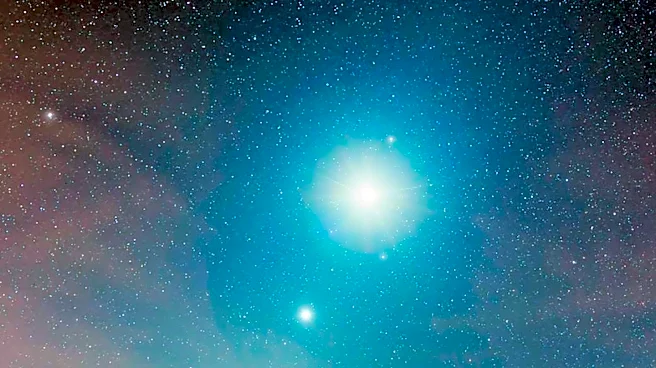
Astronomy enthusiasts are gearing up for a mini planetary alignment set to occur on July 12, 2026. This celestial event will feature the moon, Mars, Saturn, and Uranus appearing in the eastern sky just before sunrise. While the waning crescent moon, Mars, and Saturn will be visible
to the naked eye, Uranus will require high-powered binoculars or a telescope for viewing. The alignment, often referred to as a 'planetary parade,' involves several planets gathering closely on one side of the Sun. This phenomenon is not a perfect alignment but rather a visual effect as the planets' orbits meet from Earth's perspective. The best viewing conditions will be in areas without tall buildings or high mountains obstructing the view.
Why It's Important?
The mini planetary alignment offers a unique opportunity for both amateur and professional astronomers to observe the dynamics of our solar system. Such events can spark public interest in astronomy and science, encouraging educational activities and community gatherings. For scientists, these alignments provide a chance to study planetary positions and movements, contributing to a better understanding of celestial mechanics. The event also highlights the importance of preserving dark skies, free from light pollution, to ensure optimal conditions for astronomical observations.
What's Next?
Following the July 12 alignment, astronomers and skywatchers will continue to monitor the skies for future celestial events. These include other planetary alignments, meteor showers, and eclipses. Educational institutions and observatories may organize viewing events and workshops to engage the public and promote interest in space science. Additionally, advancements in telescope technology and space exploration missions will continue to enhance our ability to observe and understand the universe.