



What's Happening?
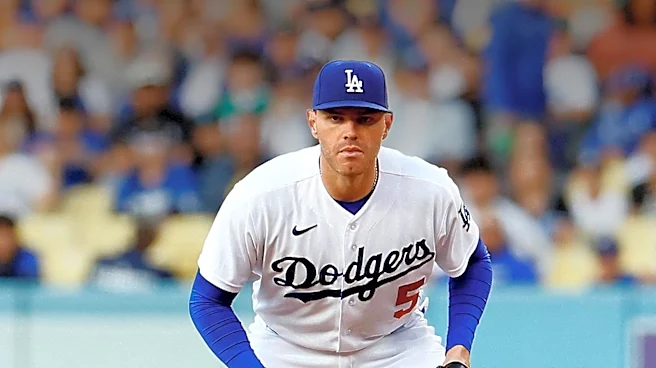
Freddie Freeman, an active hitter since 2010, has demonstrated superior career statistics when compared to David Wright, who played from 2004 to 2018. According to Baseball Data Hub, Freeman leads Wright in 13 out of 14 scored categories in their head-to-head
comparison. Key statistical advantages for Freeman include more home runs (383 to 242), a higher On-Base Plus Slugging (OPS) of .890 compared to Wright's .867, and a better batting average (.299 to .296). Freeman also holds significant leads in total hits (2,598 to 1,777) and Runs Batted In (RBI) with 1,392 against Wright's 970. Furthermore, Freeman has accumulated 3 World Series titles, while Wright has none. The Player Impact Value (PIV) metric also favors Freeman, with a career PIV of 41,593 compared to Wright's 22,524, indicating a higher overall impact adjusted for league baselines across different eras.
Why It's Important?
This statistical comparison highlights Freddie Freeman's sustained elite performance over his career, positioning him as a dominant offensive force in Major League Baseball. His consistent production in critical offensive metrics like home runs, batting average, and RBI underscores his value to any team. The PIV metric, which adjusts for era differences, further solidifies Freeman's standing as a top-tier player, suggesting his impact transcends the specific playing conditions of his time. For baseball analysts and fans, these comparisons are crucial for evaluating player legacies and potential Hall of Fame candidacies. Freeman's superior numbers in most categories, coupled with his World Series championships, contribute to a strong argument for his place among the sport's greats, influencing future discussions on player rankings and historical significance.
What's Next?
As Freddie Freeman remains an active player, his career statistics will continue to evolve, potentially widening the statistical gap between him and retired players like David Wright. Future comparisons will likely track his progress against other contemporary and historical greats, especially as he accumulates more games, hits, and home runs. His ongoing performance will influence his market value in future contract negotiations and further solidify his legacy in baseball history. Analysts will continue to monitor his PIV and other advanced metrics to assess his sustained impact. The continued accumulation of accolades and championships could further elevate his status, making him a more prominent figure in discussions about the greatest first basemen of all time.
Beyond the Headlines
The comparison between Freddie Freeman and David Wright extends beyond mere statistics, touching upon the evolution of player evaluation in baseball. The use of advanced metrics like OPS and PIV provides a more nuanced understanding of a player's overall contribution, moving beyond traditional statistics. This analytical approach allows for more accurate cross-era comparisons, helping to contextualize individual achievements within the broader history of the sport. Freeman's consistent excellence in an era of specialized pitching and advanced defensive shifts speaks to his adaptability and skill. His success also highlights the importance of longevity and sustained high-level performance in building a Hall of Fame-worthy career, influencing how future generations of players are scouted, developed, and ultimately judged.