




What's Happening?
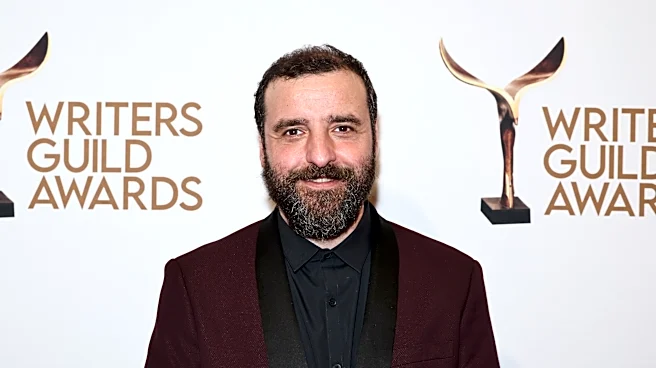
Actor David Krumholtz, known for his roles in 'Oppenheimer' and 'The Santa Clause' franchise, has announced an indefinite break from acting, expressing deep frustration with the current state of Hollywood. In a now-deleted social media post, Krumholtz stated
he is 'frustrated, fed up, fried' after over 30 years in the industry. He cited concerns about financial instability, the diminishing value of acting work, and the pressure on actors to self-promote on social media for opportunities. Krumholtz clarified that he is not entirely quitting but is stepping back to pursue a 'new, more rewarding passion.' He highlighted that his residuals from 'The Santa Clause' have significantly decreased, reportedly to around $150 per year, explaining that residuals decline with repeated airings. He believes the industry's 'conglomerate corporatizing' has shifted the rules of mutual respect, leading to a 'mass demotion' for many talented individuals.
Why It's Important?
Krumholtz's decision and his candid remarks shed light on significant challenges facing actors in the contemporary entertainment industry, particularly concerning compensation and career sustainability. His experience with dwindling residuals from a popular franchise like 'The Santa Clause' underscores a broader issue of how streaming services and evolving distribution models impact artists' long-term earnings. This situation highlights the financial precarity even for established actors, challenging the perception of consistent wealth in Hollywood. The pressure to maintain a strong social media presence for work opportunities also points to a shift in industry expectations, where self-marketing has become as crucial as talent. This trend can disproportionately affect actors who may not have the resources or inclination for constant online engagement, potentially narrowing the pathways to employment and fair compensation.
What's Next?
Krumholtz indicated he is open to acting roles if the right opportunity arises, suggesting his break is not a permanent retirement but a reevaluation of his career terms. His comments may spark further discussion within the acting community and unions regarding fair compensation, particularly residuals, in the age of streaming. Other actors facing similar financial and professional pressures might echo his sentiments, potentially leading to collective action or renewed negotiations with studios and streaming platforms. The industry may need to address the concerns raised about the 'conglomerate corporatizing' of Hollywood and its impact on artists' livelihoods to retain talent and ensure a sustainable future for creative professionals. Krumholtz's pursuit of a 'new, more rewarding passion' could also inspire other artists to seek alternative avenues for creative expression and financial stability outside traditional industry structures.
Beyond the Headlines
Krumholtz's public statement transcends a personal career decision, touching upon the evolving ethical and economic landscape of the entertainment industry. His critique of 'exploitative art' and the demand for fair pay for work that generates significant profits for employers raises fundamental questions about artistic labor rights and the distribution of wealth in Hollywood. The expectation for actors to become self-promoters on social media blurs the lines between artistic endeavor and personal branding, potentially impacting mental health and artistic integrity. This shift could lead to a more homogenized industry where marketability overshadows raw talent. Furthermore, the decline in residuals for widely consumed content highlights a systemic issue that could force many mid-career and veteran actors out of the profession, leading to a loss of diverse talent and experience within the industry. This situation prompts a re-examination of how creative contributions are valued and compensated in an increasingly digital and consolidated media environment.