







What's Happening?
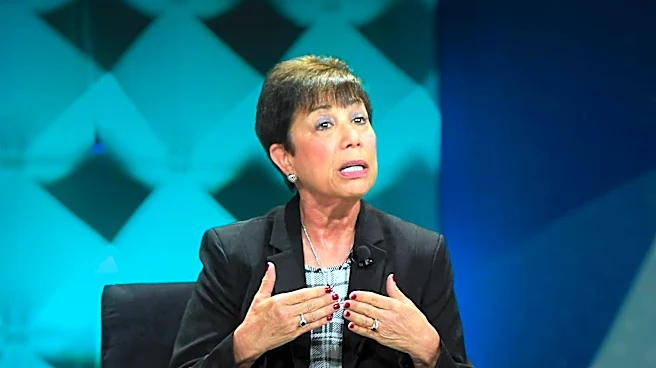
Andrew Cuomo, former governor of New York, is actively involved in shaping the future of finance, particularly in the area of tokenization. He serves on the board of OKX, a global financial-technology company, and co-chairs a joint venture between OKX and Intercontinental
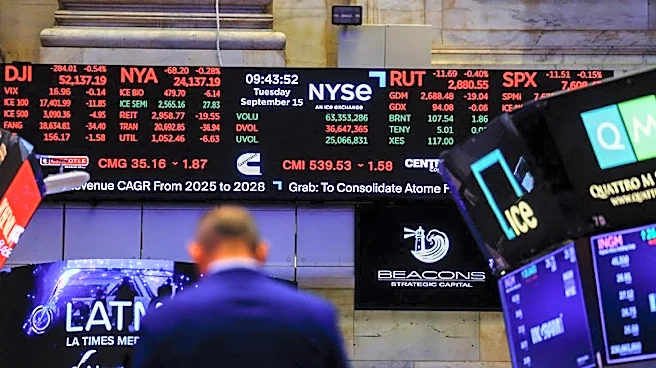
Exchange, the parent company of the New York Stock Exchange. This venture is focused on developing infrastructure for tokenized NYSE equities and other blockchain-enabled financial products. Cuomo emphasizes the critical need for the U.S. to establish clear and predictable regulatory frameworks to foster innovation while simultaneously ensuring consumer protection, anti-money laundering compliance, and cybersecurity. He highlights that technology consistently outpaces government regulation, citing artificial intelligence as a current example and drawing parallels to past financial market transformations like electronic trading and mobile banking. Cuomo points out that the U.S. has been slow to create a comprehensive regulatory framework for digital assets, contrasting it with the faster progress seen in other countries, such as the European Union's Markets in Crypto-Assets (MiCA) regulation.
Why It's Important?
The U.S. risks falling behind in the global financial landscape if it fails to establish a robust regulatory framework for digital assets and tokenization. The lack of clear rules creates uncertainty for businesses, hindering investment, job creation, and the development of new technologies within the country. Companies are more likely to build and expand in regions offering greater regulatory predictability, potentially shifting economic advantages, jobs, and tax revenues away from the U.S. The debate extends beyond cryptocurrency to the fundamental question of where the next generation of financial infrastructure will be built and which countries will lead the future of finance. Without a comprehensive statutory framework, the U.S. financial system remains vulnerable to risks from unscrupulous operators, despite the potential for blockchain technology to make financial systems faster, more efficient, more transparent, and more accessible. The current patchwork of laws and agency interpretations creates an environment where innovation and regulation are not moving in tandem, which can lead to both economic disadvantage and inadequate consumer and market protection.
What's Next?
The U.S. faces an urgent need to develop a comprehensive and durable statutory framework for the digital-asset economy. While the Securities and Exchange Commission (SEC) has taken steps like the 'Innovation Exemption' for limited trading of tokenized U.S. stocks, agency exemptions are not a substitute for comprehensive legislation. The recent failure of the Senate to advance the Digital Asset Market Clarity Act underscores the ongoing challenges in achieving consensus on regulatory responsibilities between bodies like the SEC and the Commodity Futures Trading Commission. Future efforts will likely involve continued debate and attempts to resolve disagreements over consumer protection, banking, ethics, illicit finance, and regulatory authority. The clock is ticking for the U.S. to establish clear rules, as other countries are actively writing regulations and companies are making investment decisions now. The resolution of these regulatory uncertainties will determine whether the U.S. maintains its leadership in global financial markets or cedes that position to other nations.
Beyond the Headlines
The discussion around tokenization and digital asset regulation touches upon deeper implications concerning the balance between innovation and oversight. The historical pattern of technology outpacing government highlights a recurring challenge in modern governance. The ethical dimension involves ensuring that powerful new financial technologies are used responsibly to benefit society, rather than being exploited for illicit purposes or causing harm to consumers. Legally, the establishment of clear jurisdictional lines between regulatory bodies is crucial to avoid fragmentation and provide a coherent environment for businesses. Culturally, the adoption of digital assets represents a significant shift in how value is perceived, exchanged, and stored, potentially democratizing access to financial products but also introducing new forms of risk. The long-term shift could see a fundamental restructuring of global financial markets, with tokenization reducing intermediaries and increasing efficiency, but only if accompanied by thoughtful and adaptive regulatory frameworks that can evolve with the technology.