






What's Happening?
The European Union is currently debating the definition of 'Made in Europe' within its Industrial Accelerator Act (IAA), a decision that will significantly impact its partnerships with trusted industrial partners, particularly Asian tech middle powers
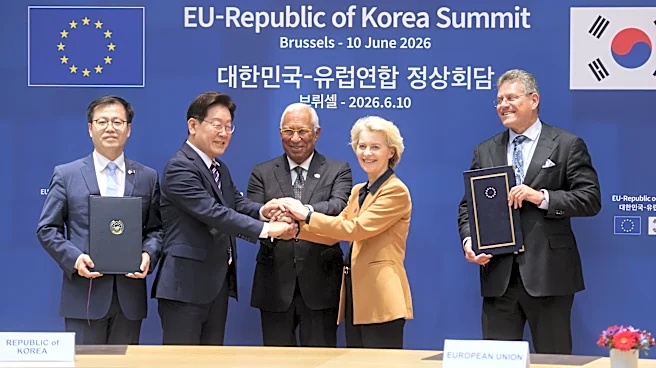
like South Korea. The IAA aims to finance the scale-up of energy-intensive industries and net-zero technologies by tying public procurement and subsidies to 'Made in Europe' content. While the European Commission's proposal includes products and components from free trade partners like Canada and South Korea as European, attempts are being made by some Member States, such as a France-Germany deal, to narrow this definition to only the UK and the European Economic Area. This debate creates uncertainty for non-EU firms and could exclude crucial partners from contributing to the EU's derisking efforts.
Why It's Important?
This debate within the EU has significant implications for the U.S. and global trade dynamics. If the EU adopts a narrow 'Made in Europe' definition, it could inadvertently create trade barriers for U.S. companies operating in or with Asian tech middle powers that are excluded from the EU's trusted partner list. This could disrupt global supply chains, increase costs for businesses, and potentially lead to retaliatory trade measures. For the U.S., which also seeks to 'derisk' its supply chains and promote domestic manufacturing, the EU's approach could serve as a precedent or a point of contention. The exclusion of advanced manufacturing partners like South Korea could also hinder global efforts to diversify supply chains away from over-reliance on single sources, potentially impacting the availability and cost of critical technologies for U.S. industries. The U.S. stands to lose if its allies create fragmented trade blocs that complicate international commerce.
What's Next?
The final decision on the 'Made in Europe' definition, expected after the European Parliament and Council vote, will determine the eligibility of products and components from various international partners for EU subsidies and procurement. A narrow definition could force Asian tech middle powers to seek alternative markets or strengthen their own regional supply chains, potentially leading to a more fragmented global economy. For the U.S., this means closely monitoring the outcome and potentially engaging in diplomatic efforts to ensure that its own trade interests and those of its key partners are not unduly harmed. It could also prompt the U.S. to re-evaluate its own 'friend-shoring' or 'near-shoring' strategies in light of the EU's protectionist tendencies. The debate highlights a broader trend towards economic nationalism and strategic autonomy, which could reshape international trade agreements and investment flows.
Beyond the Headlines
The 'Made in Europe' debate touches upon deeper ethical and economic questions regarding global interdependence versus national or regional self-sufficiency. While derisking supply chains is a legitimate goal, overly protectionist measures could lead to higher costs for consumers, stifle innovation by limiting competition, and exacerbate global inequalities by excluding developing nations from critical supply networks. Ethically, it raises questions about fairness in international trade and whether the pursuit of regional autonomy comes at the expense of global economic cooperation. Legally, it could challenge the principles of free trade agreements and the World Trade Organization, potentially leading to increased trade disputes. The long-term implication is a potential shift towards a more fragmented global economy, where strategic alliances and regional blocs dictate trade flows, rather than purely market-driven forces.