
What's Happening?
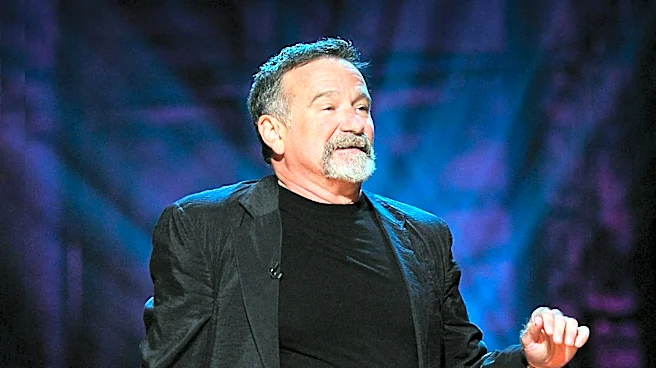
Robin Williams, a renowned actor, demonstrated significant versatility throughout his career, moving beyond pure comedy to embrace more human and ambitious comedic roles, as well as dramatic and anticipatory
films. He gained international stardom in the late 1980s with roles in 'Good Morning, Vietnam' (1987) and 'Dead Poets Society' (1989), earning Oscar nominations and a Golden Globe. Williams also took on dramatic roles in films like 'Awakenings' (1990) and 'The Fisher King' (1991). His comedic genius was further showcased in 'Mrs. Doubtfire' (1993), which significantly boosted his global popularity and earned him another Golden Globe. Later in his career, he preferred supporting roles, voice acting, and television series. Williams passed away on August 11, 2014, at the age of 63, following a severe depression, leaving behind a prolific career. Two of his films, 'Night at the Museum: Secret of the Tomb' and 'Absolutely Anything', were released posthumously.
Why It's Important?
Robin Williams' career is important for its demonstration of an actor's ability to transcend genre boundaries and maintain critical and popular appeal across diverse roles. His success in both comedic and dramatic performances, including an Oscar win for 'Good Will Hunting,' showcased a depth that challenged initial perceptions of him as solely a comedian. This versatility influenced how actors are perceived and encouraged broader casting choices in Hollywood. His work also highlighted the potential for actors to transition between film, television, and voice acting successfully. The posthumous release of his final works underscored his enduring legacy and the impact of his contributions to cinema, reminding audiences of his talent even after his passing. His life and career also implicitly bring attention to mental health struggles, given the circumstances of his death, prompting broader conversations within the entertainment industry and society.
What's Next?
While Robin Williams is no longer with us, his extensive filmography and television work continue to be celebrated and re-evaluated. His films and performances remain accessible through various streaming platforms and cinematic retrospectives, ensuring his legacy endures for new generations of viewers. Discussions about his impact on comedy and drama, as well as his personal struggles, are likely to continue in academic and popular culture. The industry may also continue to draw inspiration from his unique approach to character development and his ability to blend humor with profound emotional depth. Furthermore, his story serves as a poignant reminder of the importance of mental health awareness, a topic that continues to gain prominence within the entertainment sector and beyond.
Beyond the Headlines
Robin Williams' career extends beyond his individual performances, offering a case study in the evolution of comedic and dramatic acting in Hollywood. His ability to pivot from stand-up comedy to critically acclaimed dramatic roles, and his willingness to experiment with different genres, broadened the scope of what was expected from actors. Ethically, his public persona as a joyful and energetic performer, contrasted with his private struggles with depression, highlights the complex relationship between public image and personal well-being in the entertainment industry. Culturally, his roles often reflected and shaped societal conversations, from the inspirational teacher in 'Dead Poets Society' to the empathetic doctor in 'Patch Adams.' His legacy continues to influence aspiring actors and filmmakers, demonstrating the power of authenticity and versatility in storytelling.