



What's Happening?
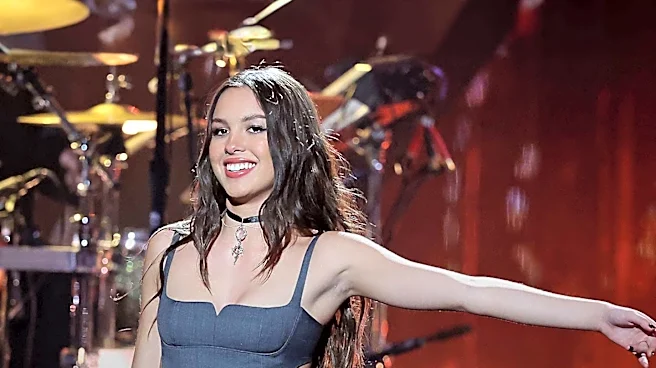
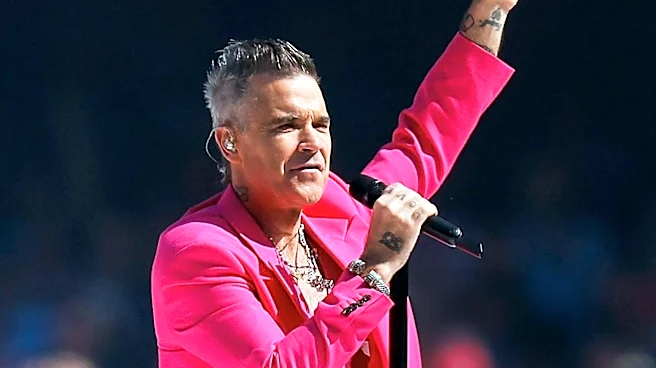
Robbie Williams has publicly defended Olivia Rodrigo against potential copyright claims regarding her new Christmas single, 'Take Me Home (4 Christmas).' Williams stated on Instagram that he believes the music industry often pursues unjustified copyright claims based
on minor similarities between songs. He acknowledged that while some claims are valid, many are 'complete bollocks.' Williams, who has faced similar accusations in the past, emphasized that there are a finite number of musical notes and chords, making accidental similarities inevitable. He expressed his admiration for Rodrigo's work, particularly her debut album 'Sour,' and stated he has no interest in pursuing any claim against her, even if a 'musical echo' of his song 'Candy' is present. He believes 'some fucking sanity has to prevail' in such situations.
Why It's Important?
This stance from Robbie Williams is significant within the music industry, which has seen an increase in copyright disputes, particularly involving younger artists. His comments highlight a growing debate about the nature of musical originality and the legal boundaries of inspiration versus infringement. For artists like Olivia Rodrigo, who has previously faced several copyright challenges, Williams's public support offers a notable counter-narrative to the often litigious environment. It could influence how future alleged similarities are perceived and handled, potentially encouraging a more lenient approach to creative echoes rather than immediate legal action. This perspective also underscores the subjective nature of musical composition and the challenges of defining unique artistic expression in a world with a long history of music.
What's Next?
While Robbie Williams has definitively stated his position, the broader conversation around music copyright and intellectual property will likely continue. Rodrigo has previously settled copyright disputes, such as those involving Paramore's Hayley Williams and Josh Faro for 'Good 4 U,' and Taylor Swift and Jack Antonoff for '1 Step Forward, 3 Steps Back' and 'Deja Vu.' Williams's statement may not prevent other parties from raising concerns if they perceive a strong similarity, but it sets a precedent from a prominent artist. The music industry may see continued discussions and potentially new guidelines or interpretations regarding what constitutes copyright infringement versus creative influence, especially as more artists speak out on the issue.
Beyond the Headlines
Williams's comments delve into the philosophical underpinnings of musical creation, suggesting that all artists build upon existing structures and sounds. His argument that 'there are only so many notes' and 'only so many chords' challenges the notion of absolute originality in music. This perspective could foster a more collaborative and less litigious environment, encouraging artists to draw inspiration from their predecessors without fear of immediate legal repercussions. It also raises questions about the role of intent in copyright law; Williams implies that accidental similarities should be treated differently from deliberate plagiarism. This could lead to a re-evaluation of how 'sampling' and 'interpolation' are viewed, potentially shifting the focus from punitive measures to acknowledging shared musical heritage.