





What's Happening?
Rimac Technology, an electric vehicle (EV) technology company specializing in battery, powertrain, and electronic systems, has announced a Joint Development Agreement with ECOBLOX, a global innovator in AI compute infrastructure. This partnership aims
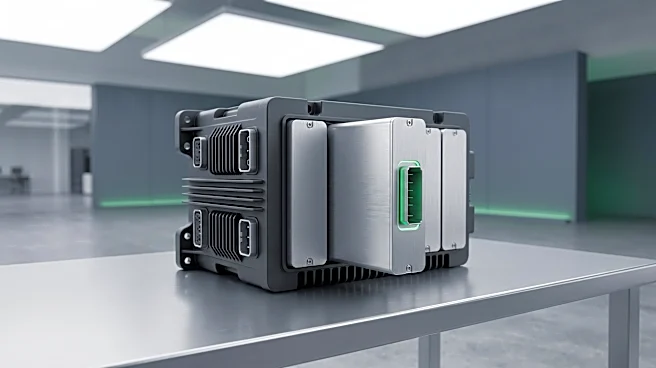
to deliver a state-of-the-art Modular Data Center (MDC) solution. The collaboration will integrate Rimac Technology’s UNI battery modules and power electronics into ECOBLOX’s AI infrastructure, MDC architecture, design, and hardware/software system integration. The goal is to address the increasing demand for computing power driven by AI and high-performance computing, which often faces challenges related to energy availability, cooling capacity, and deployment space. Rimac Technology's UNI battery modules, developed to automotive standards, offer high-performance density, compact packaging, built-in safety, and advanced thermal management. These modules are designed for various applications, including automotive, energy storage, marine, off-highway, commercial, industrial, and now AI infrastructure. The joint MDC solution will streamline serviceability and provide longer continuous backup power for critical computing hardware, with a Battery Management System (BMS) offering real-time monitoring and control.
Why It's Important?
This partnership signifies a crucial step in addressing the escalating energy demands of AI and high-performance computing infrastructure. By integrating automotive-grade battery and power electronics technology into data centers, the solution aims to overcome grid constraints and enable faster, more efficient deployment of scalable, power-resilient AI clusters. The move is particularly important as AI compute transitions towards higher voltage architectures (400 VDC and 800 VDC), requiring advanced power solutions. The collaboration leverages Rimac Technology's decade of high-voltage engineering expertise, applying it to a new high-power application where power density, thermal management, safety, and reliability are critical. For ECOBLOX, an NVIDIA Preferred Partner, this integration enhances their ability to deliver complete, end-to-end AI infrastructure, from factory-engineered MDCs to full GPU system integration. This innovation could significantly impact the efficiency and sustainability of AI data centers, potentially reducing operational costs and environmental footprint while boosting computational capabilities.
What's Next?
The completed modular data center is scheduled for installation at the Rimac Campus near Zagreb, Croatia, in November 2026. This installation will serve as a live demonstration of the joint solution and a platform for engaging with potential customers and partners. The partnership aims to redefine high-density power delivery for the next generation of AI compute, enabling cloud providers, enterprises, and sovereign entities to deploy turnkey, exascale-ready compute directly at local power sources within 6 to 8 months. Further developments will likely focus on scaling this technology and exploring its application in various high-demand computing environments. The success of this initial deployment will be crucial in demonstrating the viability and benefits of integrating automotive-grade battery technology into AI data centers, potentially leading to broader adoption and further innovation in the field.
Beyond the Headlines
The collaboration between Rimac Technology and ECOBLOX highlights a broader trend of cross-industry innovation, where technologies developed for one sector, such as electric vehicles, are being adapted to address challenges in others, like artificial intelligence. This convergence underscores the increasing importance of efficient power management and energy storage across diverse technological landscapes. The emphasis on high-density, safe, and reliable power solutions for AI infrastructure also brings to light the growing environmental and logistical concerns associated with the rapid expansion of data centers. By providing more efficient and resilient power systems, this partnership could contribute to more sustainable AI development. Furthermore, the integration of sophisticated Battery Management Systems (BMS) for real-time monitoring and control reflects a move towards more intelligent and autonomous energy management in critical infrastructure, potentially setting new industry standards for data center operations and reliability.