








What's Happening?
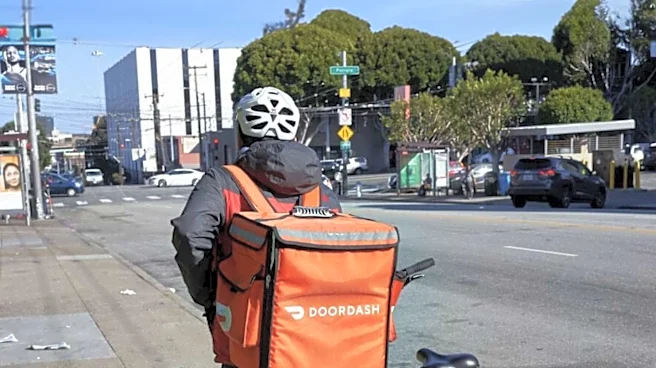
DoorDash CEO Tony Xu has indicated that third-party AI agents have generated only a few hundred orders in total for the company. This statement comes amidst broader discussions about the effectiveness and adoption of personal AI agents like Muse and Instinct
in the e-commerce and service industries. Similarly, Airbnb's Brian Chesky noted that bookings from these agents constitute a 'very non-material' portion of their nearly half a million daily bookings. The low volume of orders and bookings attributed to AI agents raises questions about their current utility and integration into consumer behavior. One theory suggests that platforms may struggle to accurately detect interactions from these agents, especially when they operate through browsers and apps. Another perspective is that the technology and its widespread adoption are still in nascent stages, implying that their impact could grow over time as the tools improve and user confidence increases. The current data primarily reflects completed transactions, which may not fully capture the extent of work AI agents perform in the research and comparison phases of consumer decision-making.
Why It's Important?
The limited impact of third-party AI agents on order generation for major platforms like DoorDash and Airbnb is significant for the technology and e-commerce sectors. It suggests that despite advancements in AI, these agents have not yet become a substantial channel for consumer transactions. This could influence investment decisions in AI agent development and integration strategies for businesses. Companies might re-evaluate the immediate return on investment for features designed to interact with AI agents, potentially shifting focus to other areas of technological innovation or customer engagement. For consumers, it indicates that while AI agents can assist with research and comparison, the final decision-making and transaction processes largely remain human-driven. This also highlights a potential gap between the capabilities of AI agents and their practical application in generating direct sales, prompting a need for further development to enhance their transactional efficacy and user trust. The findings also challenge the perception that AI agents are rapidly transforming online commerce, suggesting a more gradual evolution.
What's Next?
The future trajectory of third-party AI agents will likely involve continued development aimed at improving their ability to complete transactions and gain user trust. As AI tools become more sophisticated, platforms may also enhance their detection mechanisms to better track and attribute orders generated by these agents. This could lead to a more accurate assessment of their value. Businesses might explore deeper integrations with AI agents, moving beyond simple order generation to more complex tasks like personalized recommendations and proactive service delivery. The industry may also see a shift in how AI agents are designed, focusing on user preferences for delegation—where some users prefer agents to handle research while they complete the final booking. This could lead to a hybrid model where AI agents augment human decision-making rather than fully automating the purchasing process. The coming years will likely reveal whether these agents evolve into significant transaction drivers or remain primarily as research and comparison tools.
Beyond the Headlines
Beyond the immediate transaction numbers, the limited adoption of AI agents raises deeper questions about human-computer interaction and consumer psychology. The preference of many users to personally complete purchases, even after an AI agent has done the preliminary work, suggests a lingering need for human oversight and control in financial transactions. This could be due to trust issues, the desire for personal verification of details, or simply the enjoyment derived from the act of shopping or planning. Ethically, the development of AI agents also brings considerations of data privacy and algorithmic bias, especially as they become more integrated into personal decision-making. Legally, the attribution of responsibility in cases of errors or disputes arising from AI-generated transactions could become a complex area. Culturally, the slow adoption might indicate a broader societal resistance to fully delegating personal tasks to AI, highlighting the enduring value placed on human agency and judgment in consumer choices. This ongoing dynamic will shape the future of AI in daily life.