




What's Happening?
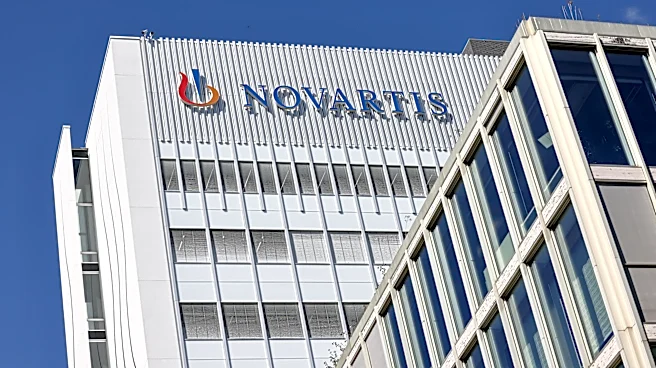
Vas Narasimhan, Chief Executive Officer of Novartis AG, has voiced concerns that proposed U.S. restrictions on biotech investments in China could impede the development of new medicines. In a Bloomberg interview, Narasimhan emphasized the critical role
of technology transfer between the U.S. and China for advancing drug development. He stated that the current approach could limit the ability to bring technologies into U.S. factories for U.S. patients and vice versa. Narasimhan hopes for more sensible approaches to emerge from ongoing discussions, arguing that finding new treatments for cancer or heart disease is not a national security issue and breakthroughs should be accessible to patients in both countries. The Treasury Department recently moved to include biotechnology on a list of sensitive technologies facing investment limits with foreign adversaries, expanding a program under the Comprehensive Outbound Investment National Security (COINS) Act, which already targets artificial intelligence, semiconductors, and quantum computing. This could affect multinational drugmakers with U.S. operations, including Switzerland-based Novartis.
Why It's Important?
The potential U.S. restrictions on biotech investments in China carry significant implications for the pharmaceutical industry and global health. For Western drugmakers like Novartis, the U.S. is the primary commercial market, with China ranking second and playing an increasingly vital role in supplying new medicines and technologies. Limiting cross-border biotech collaboration could hinder research and development efforts, making it more challenging for companies to access critical markets in both the U.S. and China. This policy is part of a broader U.S. initiative to curb China's biotech advancements, following last year's Biosecure Act, which restricted federal agencies and government-funded companies from using services from certain Chinese biotech firms. If these restrictions advance, they could slow the creation of new drugs, potentially delaying access to life-saving treatments for patients in both countries and impacting the financial portfolios of investors in the biotech sector.
What's Next?
The ongoing discussions surrounding the proposed U.S. restrictions on biotech investments in China will determine the future landscape of pharmaceutical research and development. Stakeholders, including pharmaceutical companies, government officials, and patient advocacy groups, will likely continue to engage in dialogue to shape these policies. The outcome could lead to either a more restrictive environment, potentially slowing innovation and market access, or a more nuanced approach that balances national security concerns with the imperative of global health advancement. The Treasury Department's actions indicate a clear intent to broaden investment limits, suggesting that the biotech industry will need to adapt to a potentially more regulated cross-border investment climate. Companies like Novartis will be closely monitoring these developments to adjust their long-term planning and investment strategies.
Beyond the Headlines
Beyond the immediate economic and scientific implications, these proposed restrictions touch upon deeper ethical and geopolitical considerations. The debate over whether medical breakthroughs constitute a national security issue highlights a tension between global scientific collaboration for the common good and national interests in technological supremacy. The potential for reduced access to new treatments due to geopolitical tensions raises questions about the universal right to health and the role of governments in facilitating or impeding medical progress. Furthermore, such policies could foster a more fragmented global biotech ecosystem, potentially leading to duplicated research efforts and reduced efficiency in addressing global health challenges. The long-term impact could be a shift in how pharmaceutical innovation is conducted, with a greater emphasis on regional self-sufficiency rather than global interdependence, potentially altering the trajectory of medical science for decades to come.