





What's Happening?
Digital manufacturing, encompassing additive manufacturing, rapid prototyping, and on-demand production, is transforming the medical device industry. This approach allows companies to validate product concepts more quickly, reduce development risks, and scale
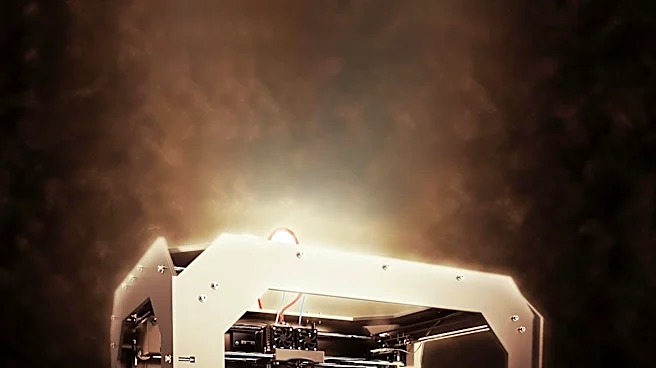
production efficiently from initial design to commercialization. Traditionally, moving a medical product to market involved significant compromises, with lengthy tooling investments and high costs for design changes. Digital manufacturing removes these constraints by enabling products to evolve throughout the development process without requiring substantial upfront investments. Engineers can use CAD software to create digital models, which are then rapidly converted into physical parts through additive manufacturing, allowing for quicker validation of functionality, refinement of ergonomics, and gathering of clinician feedback. This accelerated process leads to a more informed development cycle, where decisions are based on physical testing rather than assumptions.
Why It's Important?
The adoption of digital manufacturing is crucial for the U.S. medical device industry as it addresses the challenges of rapid innovation and regulatory requirements. By accelerating product development, companies can bring life-saving and life-improving medical devices to market faster, benefiting patients and healthcare providers. This technology also supports bridge manufacturing, allowing for low-volume production batches for clinical evaluations, pilot programs, and market testing before full-scale investment in production tooling. This reduces financial risk and allows companies to gather real-world feedback. Furthermore, digital manufacturing facilitates personalized healthcare solutions, enabling the creation of patient-specific orthoses, prosthetics, surgical planning models, and customized medical device components. This level of personalization, previously difficult to achieve economically with traditional methods, is becoming increasingly vital in modern healthcare, offering tailored solutions to individual patient needs.
What's Next?
The medical manufacturing sector is expected to continue its shift towards more agile, personalized, and rapid production models. Companies that embrace digital manufacturing will be better positioned to respond to evolving clinical needs, patient expectations, and competitive markets. The flexibility offered by additive manufacturing means that manufacturers can adopt on-demand production models, reducing inventory risk and minimizing waste. This also allows for the seamless implementation of design improvements without creating obsolete stock. As digital manufacturing technologies advance, their capabilities will expand, further integrating into every stage of the product lifecycle, from initial design validation to industrial additive manufacturing and low-volume production. This will lead to a more resilient and responsive manufacturing strategy within the U.S. medical industry, fostering continuous innovation and quicker market entry for new medical technologies.
Beyond the Headlines
The widespread adoption of digital manufacturing in the medical sector has deeper implications beyond just speed and cost efficiency. Ethically, it raises questions about the accessibility and affordability of highly personalized medical devices. While customization is a significant advantage, ensuring equitable access to these advanced solutions will be a key consideration. Legally, the rapid iteration and on-demand production capabilities may necessitate updates to regulatory frameworks to ensure product safety and efficacy in a more dynamic manufacturing environment. Culturally, this shift could lead to a greater expectation for personalized healthcare solutions among patients, pushing the industry towards even more tailored approaches. The long-term impact includes a potential decentralization of manufacturing, allowing for more localized production and potentially reducing supply chain vulnerabilities, thereby enhancing national healthcare resilience.