







What's Happening?
Claude Monet, a pivotal figure in the Impressionist movement, passed away on December 5, 1926, at the age of eighty-six due to lung cancer. He was interred in the church cemetery at Giverny. His funeral was a modest affair, attended by approximately fifty
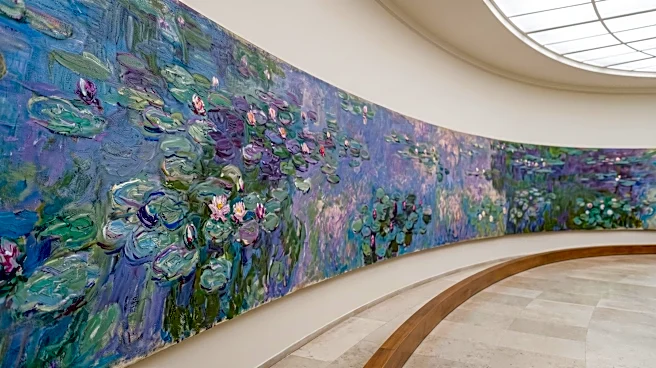
individuals. Notably, Georges Clemenceau, a statesman and friend, replaced the traditional black funeral cloth with a flowered one, asserting that black was unsuitable for Monet. A year after his death, in 1927, his significant 'Water Lilies' decorations were unveiled at the Musée de l'Orangerie in Paris. Initially, their reception was subdued, but by the 1950s, a new generation of artists, particularly Abstract Expressionists, rediscovered and admired the scale and freedom of these works. Monet's artistic journey began in Paris in 1840, and he later moved to Le Havre. Despite his father's wishes for him to join the family business, Monet pursued art, supported by his mother. His early career was shaped by mentors like Eugène Boudin, who taught him to paint outdoors, a practice that became central to his artistic development.
Why It's Important?
Monet's enduring influence on the art world, particularly in the United States, is significant. His 'Water Lilies' series, initially met with muted reception, later became a source of inspiration for American Abstract Expressionists in the 1950s. This rediscovery highlights how European artistic movements can profoundly shape and inform subsequent American art forms, demonstrating a continuous transatlantic dialogue in artistic innovation. His dedication to capturing light and atmosphere, as seen in his series paintings of haystacks, poplars, and Rouen Cathedral, laid foundational principles for modern art. These works challenged traditional artistic conventions and paved the way for new approaches to depicting reality, impacting art education and appreciation across the globe, including in American art institutions. The continued study and exhibition of his work in the U.S. contribute to a deeper understanding of art history and its evolution.
What's Next?
Monet's legacy continues to be preserved and celebrated through various institutions. His son, Michel, bequeathed the house, garden, and water lily pond at Giverny to the Académie des Beaux-Arts in 1966. Since 1980, these sites have been accessible to the public through the Fondation Claude Monet, allowing visitors, including many from the United States, to experience the environment that inspired his most famous works. The ongoing scholarly work, such as Daniel Wildenstein's catalogue raisonné, ensures the meticulous documentation and study of his extensive body of work. This continuous research and public access mean that Monet's art will remain a subject of academic inquiry and public fascination, influencing future generations of artists and art enthusiasts worldwide, including those in the U.S. who visit Giverny or view his works in American museums.
Beyond the Headlines
Monet's artistic journey was marked by personal challenges, including financial difficulties and the loss of loved ones. His resilience in continuing to paint despite these hardships, and even as his eyesight deteriorated due to cataracts, offers a profound insight into the dedication required for artistic mastery. The transformation of his vision due to cataracts, and his subsequent operations, influenced his later works, adding a unique dimension to his artistic evolution. This aspect of his life underscores the human element behind artistic creation, where personal struggles can inadvertently shape and enrich an artist's output. His ability to adapt and innovate, even in the face of physical decline, provides a powerful narrative about perseverance and the subjective nature of perception, resonating with artists and audiences who grapple with similar challenges, both personal and artistic.