




What's Happening?
Mario Vargas Llosa, a highly acclaimed writer and Nobel Prize laureate, passed away in 2025. His career was marked by numerous literary achievements, beginning with his debut novel, 'The Time of the Hero,' which won the Premio Biblioteca Breve in 1963.
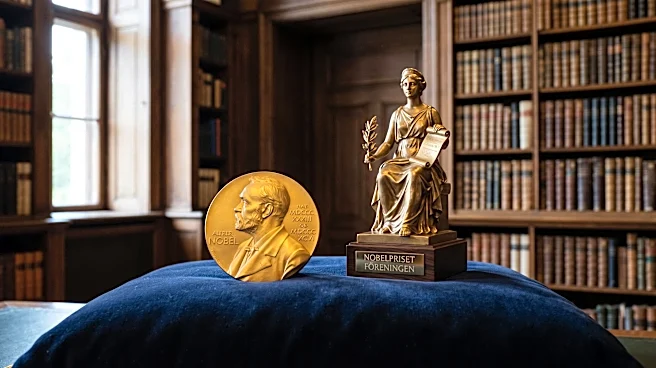
This initial success was followed by a series of triumphs, culminating in the 2010 Nobel Prize in Literature. Further recognition included being granted a hereditary noble title by the King of Spain in 2011 and, in 2023, becoming the first non-Francophone author to be inducted into the Académie Française. Vargas Llosa's literary ascent occurred during a period when the status of novelists was diminishing due to the rise of electronic media. He critically addressed this societal shift in his 2012 essay collection, where he decried the 'civilization of the spectacle,' foreshadowing contemporary concerns about post-literacy.
Why It's Important?
The passing of Mario Vargas Llosa marks the end of an era for a writer who, despite the changing landscape of media and literature, strived to maintain the towering stature of the novelist. His career highlights the enduring power of narrative and critical thought in an increasingly digital world. Vargas Llosa's critique of the 'civilization of the spectacle' remains highly relevant, offering insights into the challenges faced by traditional literary forms in an age dominated by electronic media. His efforts to elevate the novelist's role, even as its cultural prominence waned, underscore a significant struggle within the arts to retain influence and depth against the tide of rapid technological advancement and shifting public consumption habits. His work and commentary provide a valuable lens through which to understand the evolution of intellectual discourse and the arts in the 20th and 21st centuries.
What's Next?
The legacy of Mario Vargas Llosa is expected to continue influencing literary studies and critical discourse. His extensive body of work, including novels and essays, will likely be subject to renewed academic interest and public appreciation. Discussions surrounding the 'civilization of the spectacle' and the role of literature in a media-saturated society, themes central to Vargas Llosa's later writings, are anticipated to persist and evolve. Literary institutions and critics may further explore how his career navigated the decline in the novelist's status, offering lessons for contemporary writers and artists. Posthumous analyses of his contributions to Latin American literature and global intellectual thought are also expected, solidifying his place as a significant figure in modern literary history.
Beyond the Headlines
Vargas Llosa's career and his critique of the 'civilization of the spectacle' offer profound insights into the broader cultural shifts of the late 20th and early 21st centuries. His aspiration to achieve a stature akin to Jean-Paul Sartre, despite the changing cultural landscape, highlights a fundamental tension between artistic ambition and societal evolution. This struggle points to deeper questions about the value placed on intellectual depth and sustained engagement in an era of instant gratification and fragmented attention spans. His induction into the Académie Française as a non-Francophone author also signifies a broader recognition of global literary contributions, transcending linguistic and national boundaries. This aspect of his legacy underscores the universal appeal and impact of his storytelling and critical perspectives, challenging traditional notions of cultural gatekeeping.