








What's Happening?
Uber CEO Dara Khosrowshahi is actively expanding the company's autonomous vehicle partnerships and growing its freight business. According to results released on November 4, Uber's gross bookings increased by 20 percent in the three months ending September
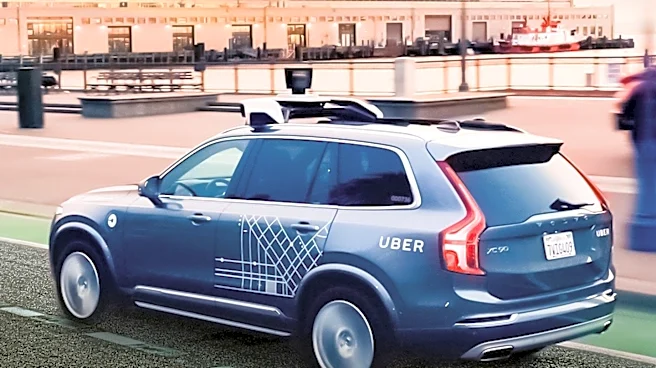
30, with 215 million monthly active consumers utilizing both rides and delivery services. The company's non-GAAP operating income rose by 38 percent to $2.3 billion, and free cash flow reached $2.5 billion. Revenue saw a 10 percent increase year-over-year, totaling $14.8 billion. Uber reported earnings of 25 cents per share under standard accounting rules and 88 cents on an adjusted basis. The freight division experienced a 34 percent revenue jump to $1.76 billion in the same period, though it still recorded a $33 million operating loss. Khosrowshahi anticipates having approximately 700 fully driverless vehicles on the Uber platform by year-end, with plans to exceed 2,000 by 2027. Uber is collaborating with companies like Nuro, Rivian, Avride, Lucid, and Zoox for its autonomous fleet, and has launched services with Motional in Las Vegas.
Why It's Important?
Uber's aggressive push into autonomous vehicles and the expansion of its freight business signify a strategic pivot towards long-term growth and efficiency. The company's substantial investment in robotaxis, estimated to be over $10 billion, indicates a commitment to transforming its core mobility services. This shift could potentially reduce operational costs associated with human drivers in the future, although profitability for robotaxi fleets is yet to be definitively proven. The growth in Uber Freight highlights the company's ambition to disrupt the logistics industry by addressing inefficiencies like 'empty miles' for truckers, mirroring its impact on personal transportation. Success in these ventures could solidify Uber's position as a dominant player in both mobility and logistics, potentially reshaping how goods are transported and how people move. However, managing the significant capital investments required for autonomous vehicles while balancing investor expectations will be a critical challenge, as immediate returns are not expected.
What's Next?
Uber plans to initiate fully driverless testing with Nuro and Lucid this quarter, with commercial service expected to commence in the San Francisco Bay Area early next year, followed by Houston and other cities. The company aims to scale its robotaxi ecosystem significantly, targeting tens of thousands of vehicles by 2028 and beyond. Uber's strategy involves leveraging existing demand in these markets, as stated by CEO Khosrowshahi, who noted that the company already has established relationships and operations in these cities. The deployment of autonomous vehicles will continue through partnerships with various automakers, including Lucid and Rivian, which are slated to supply a substantial number of vehicles. The coming years will be crucial for Uber to demonstrate the cost-effectiveness and scalability of its autonomous vehicle operations, as hardware costs need to decrease for broader deployment to become viable.
Beyond the Headlines
Uber's dual focus on expanding its robotaxi fleet and growing its freight business points to a broader vision of becoming a comprehensive logistics and mobility platform. The company's move into autonomous vehicles raises significant questions about the future of gig economy labor, as a successful transition to driverless operations could drastically alter the demand for human drivers. This could lead to socio-economic impacts, including job displacement and the need for new workforce training initiatives. Furthermore, the ethical and regulatory frameworks surrounding autonomous vehicles are still evolving, presenting potential challenges related to safety, liability, and public acceptance. Uber's strategy of partnering with multiple vehicle manufacturers rather than developing its own autonomous technology reflects a platform-centric approach, aiming to be the primary interface for various mobility solutions. This could set a precedent for how other technology companies integrate advanced hardware into their service offerings, emphasizing collaboration over vertical integration in certain sectors.