





What's Happening?
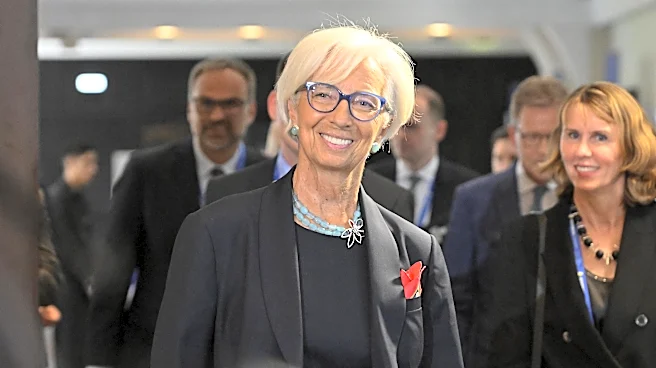
European Central Bank (ECB) President Christine Lagarde has emphasized the critical need for Europe to bolster its economic sovereignty. Speaking at the 36th Frankfurt European Banking Congress on November 20, Lagarde highlighted Europe's significant
reliance on international payment providers and foreign technology infrastructure, which exposes the region to strategic risks. She urged for increased investment in domestic alternatives and shared European systems, citing that over 60% of card payments in Europe are processed by international schemes. Lagarde identified key areas for accelerated efforts, including AI computing capacity, deeper capital markets integration, and more resilient financial infrastructure. To address these challenges, she presented the digital euro as a potential European payment alternative, with a target readiness for issuance in 2029, provided necessary legislation is adopted by the end of 2026. Additionally, Lagarde underscored the opportunities presented by blockchain technology for European capital markets, referencing initiatives like Eurosystem’s Pontes and Appia, which aim to facilitate tokenized transactions and establish common standards for tokenized assets.
Why It's Important?
The push for European economic sovereignty by ECB President Christine Lagarde carries significant implications for global financial and technological landscapes, including potential indirect effects on U.S. interests. Europe's reduced reliance on international payment providers, many of which are U.S.-based, could lead to a shift in market share and revenue for these companies. The development of a digital euro and European blockchain initiatives could create a more competitive environment in digital finance, potentially influencing global standards and adoption rates for central bank digital currencies and tokenized assets. For U.S. businesses operating in Europe, these changes might necessitate adaptations to new payment systems and financial infrastructures. Furthermore, a stronger, more independent European economy, as envisioned by Lagarde, could alter geopolitical dynamics and trade relationships, potentially impacting U.S. economic and strategic partnerships. The emphasis on AI computing capacity and capital markets integration also signals Europe's ambition to compete more vigorously in high-tech sectors, which could affect U.S. dominance in these areas.
What's Next?
The ECB aims to be ready for a first issuance of the digital euro in 2029, contingent on the adoption of necessary legislation by the end of 2026. This timeline suggests a period of legislative development and technical preparation over the next few years. The Eurosystem's Pontes initiative, which enables tokenized transactions, has already seen the European Stability Mechanism settle a €1 billion digitally native bond, indicating ongoing progress in blockchain adoption. The Appia initiative will continue its work towards an integrated European market for tokenized assets, requiring legislative action to establish common rules. These developments will likely involve continued collaboration among European institutions and potentially influence international discussions on digital currencies and blockchain regulation. The focus on strengthening the international role of the euro could also lead to further policy discussions and initiatives aimed at reducing Europe's exposure to exchange-rate fluctuations and supporting strategic investments.
Beyond the Headlines
The drive for European economic sovereignty, as articulated by Christine Lagarde, extends beyond immediate financial and technological shifts, touching upon deeper ethical and cultural dimensions. The emphasis on reducing reliance on foreign infrastructure can be seen as a move to reclaim digital autonomy and protect European data and financial privacy from external oversight. This could lead to a re-evaluation of data governance and cybersecurity standards within Europe, potentially setting new benchmarks that influence global practices. Culturally, fostering domestic alternatives and shared European systems could reinforce a sense of collective identity and resilience, promoting a 'Made in Europe' ethos in critical sectors. The ethical implications of a digital euro, such as privacy concerns and the potential for state control over transactions, will also be a significant area of debate as the project progresses. This push for sovereignty reflects a broader global trend where nations are increasingly seeking to control their digital and economic destinies, raising questions about the future of globalization and interconnectedness.