




What's Happening?
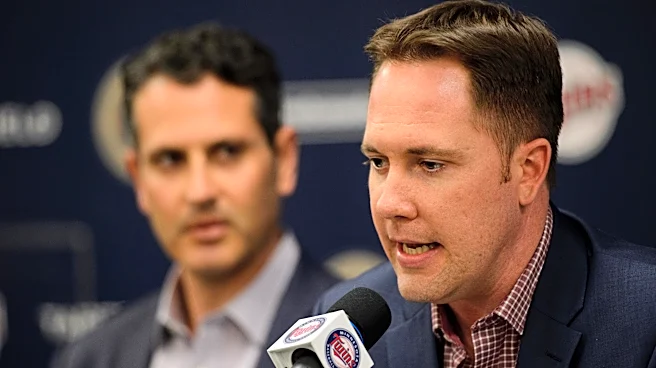
The Minnesota Twins are signaling a significant shift in their offseason strategy, informing players, agents, and media that they intend to be active participants in the upcoming free-agent market. This declaration comes as the current Collective Bargaining
Agreement (CBA) is set to expire on December 1, with expectations of a potential work stoppage due to disagreements between owners, who reportedly seek a salary cap, and players, who are determined to prevent it. Historically, the Twins have not been known for high spending in free agency. However, national baseball writer Bob Nightengale reported that the 'Twins are telling everybody' about their intent to engage in the market. The team is particularly focused on retaining their catcher, Ryan Jeffers, who is scheduled to become a free agent after a strong 2026 season where he posted a .256/.353/.461 slash line with 14 home runs and 56 RBIs in 92 games, following a career-high 21 home runs in 2023.
Why It's Important?
The Twins' announced aggressive approach to free agency could significantly alter their competitive standing within the American League Central, where they finished behind the Cleveland Guardians and potentially the Chicago White Sox in recent seasons. This strategic pivot suggests a desire to build a more competitive roster, potentially through key signings that could address immediate needs. The timing of their declaration, just before the CBA expiration, adds another layer of complexity. A potential work stoppage could freeze player movement and impact team building, making early contract offers crucial for teams looking to secure talent. For players, the impending CBA negotiations mean that securing deals before December 1 could offer more stability, especially if a lockout occurs. The MLBPA's historical success in negotiations indicates they are prepared for a prolonged stance against owner demands for a salary cap, which could influence the pace and nature of free-agent signings.
What's Next?
The immediate focus for the Minnesota Twins will be on making at least one or two key signings before the December 1 CBA expiration. Their primary target appears to be re-signing catcher Ryan Jeffers, who is a valuable asset coming off a productive season. While a top-tier pitcher like Tarik Skubal might be outside their price range, the Twins' stated intent suggests they will pursue other impactful players. The broader MLB landscape will be dominated by the looming CBA negotiations. If owners push for a salary cap and players resist, a significant work stoppage is anticipated. This could lead to a flurry of early free-agent activity as teams and players try to finalize deals before a potential lockout. The outcome of these negotiations will dictate the financial structure of MLB for years to come and directly influence how teams like the Twins can operate in future free-agent markets.
Beyond the Headlines
The Minnesota Twins' shift towards a more aggressive free-agency strategy could signal a broader trend among mid-market teams to invest more heavily in talent, potentially driven by increased revenue streams or a desire to break out of competitive stagnation. This move also highlights the growing tension between MLB owners and players regarding the economic structure of the league. The owners' reported desire for a salary cap, a long-standing point of contention, reflects a push for greater cost control and competitive balance from their perspective. Conversely, the players' staunch opposition underscores their commitment to maintaining the current free-market system, which has historically benefited them in negotiations. The impending CBA negotiations are not just about player salaries but also about the fundamental economic philosophy of professional baseball, with potential long-term implications for player movement, team payrolls, and the overall competitive landscape of MLB.