





What's Happening?
Janet L. Jones, a neuroscientist and horse trainer, has identified several inaccuracies in Ann Patchett's novel 'Whistler' concerning horse behavior, despite the book's central equine narrative. While Patchett accurately portrays horses forming deep bonds
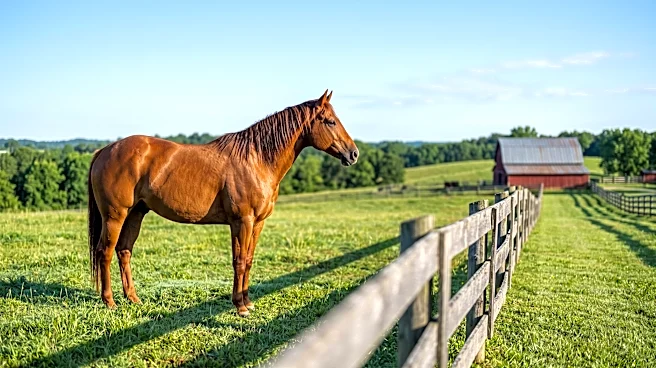
with humans and responding to whistles, Jones points out that a third-generation ranch woman like the character Mary would likely not have searched for a missing horse, Nutmeg, in the manner described. Horses, being herd animals, typically return to their herdmates if they wander off. Furthermore, the novel's depiction of Whistler, Mary's horse, lying down to allow an injured Mary to mount is highly improbable. Although healthy horses do lie down to rest, it is unlikely they would do so with the complex intent of saving a human life. Jones suggests that Whistler's action was more likely an imitation of Mary's prone position, a behavior observed in bonded equine affiliates.
Why It's Important?
This analysis highlights a common challenge in fiction writing, where authors may inadvertently misrepresent specialized knowledge, even when it forms a core element of their narrative. For readers with expertise in equine behavior, these inaccuracies can detract from the story's realism. More broadly, it underscores the importance of factual accuracy in storytelling, particularly when dealing with subjects that have dedicated scientific study. While creative license is often accepted, significant deviations from established facts can impact a work's credibility among informed audiences. The critique also implicitly advocates for deeper research by authors into the subjects they portray, ensuring that their narratives, even if fictional, are grounded in plausible realities.
What's Next?
This critique may prompt future authors to engage in more rigorous research when incorporating specialized subjects like animal behavior into their works. For readers, it serves as a reminder to critically evaluate fictional portrayals against real-world knowledge. The discussion could also encourage a broader conversation within literary circles about the balance between creative storytelling and factual accuracy, particularly in genres that touch upon scientific or technical fields. It might also lead to increased collaboration between authors and subject matter experts to enhance the authenticity of fictional narratives.
Beyond the Headlines
The discussion around 'Whistler' extends beyond mere factual errors to touch upon the ethical considerations of representation in literature. When a story features animals, especially those with which humans form deep connections, misrepresenting their capabilities or motivations can perpetuate misunderstandings about them. This can have subtle but far-reaching implications for how the public perceives and interacts with these animals. The critique also implicitly raises questions about the responsibility of authors to their readers and to the subjects they portray, suggesting that even in fiction, there is a value in striving for a truthful depiction of the world, or at least acknowledging when creative liberties are taken. This fosters a more informed and nuanced understanding of the world, even through the lens of imagination.