


What's Happening?
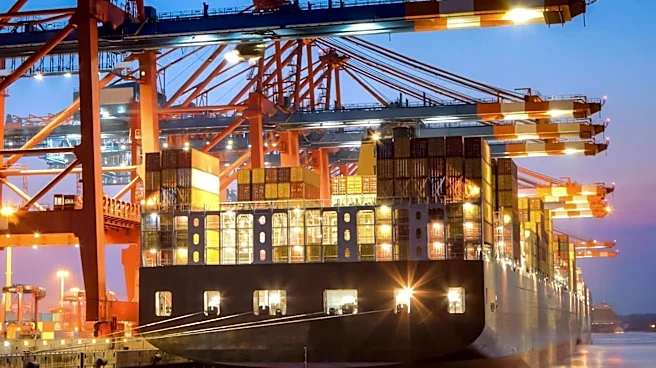
G20 economies are implementing a growing number of trade restrictions, with accumulated import-related restrictive measures reaching a record $4.5 trillion by June 2026, covering nearly 30% of G20 imports. During the first half of 2026, G20 nations introduced
697 trade and trade-related measures, including 206 restrictive policies, surpassing the 194 recorded in the entire previous year. These new import-related measures impacted $2 trillion in trade, equivalent to 12.9% of G20 imports. Export restrictions have also dramatically expanded, covering $711 billion in trade in the first half of 2026, up from $126 billion in 2025. Despite this increase in barriers, international merchandise trade has performed better than anticipated, with the WTO raising its forecast for global merchandise trade volume growth in 2026 to 3.9%. WTO Director-General Ngozi Okonjo-Iweala has urged restraint in introducing further restrictions while promoting trade-facilitating efforts.
Why It's Important?
The simultaneous increase in trade restrictions and acceleration of global commerce presents a complex challenge for U.S. businesses and the global economy. As G20 economies account for 80-85% of global GDP and 75% of international trade, their policy decisions significantly influence the operating conditions for international businesses. The persistence of existing measures, with import-related restrictions introduced since 2009 now covering 29.6% of G20 imports, creates an increasingly complicated trading environment. U.S. companies face heightened uncertainty and potential disruptions to supply chains and market access due to tariffs, export controls, and sector-specific interventions. While some trade-facilitating measures are also being introduced, the net economic effect is unclear, and the long-term accumulation of trade barriers could undermine regulatory predictability and economic growth for U.S. and international stakeholders.
What's Next?
The global trading system faces the ongoing challenge of balancing restrictive and facilitating trade measures. G20 economies are expected to continue engaging in negotiations to address trade imbalances and utilize WTO transparency mechanisms to resolve disputes. The call from WTO Director-General Ngozi Okonjo-Iweala for restraint in new restrictions and encouragement of trade-facilitating efforts suggests a push towards more balanced policies. However, the underlying geopolitical disruptions and competing policy priorities that drive these interventions are likely to persist. Businesses will need to adapt to an environment where trade policies are dynamic and often contradictory, requiring robust strategies for navigating market access and supply chain management. The resilience of merchandise trade, partly driven by demand for AI-enabling products, will be a key factor in determining the overall economic outlook.
Beyond the Headlines
The current trade landscape highlights a deeper shift in global economic policy, moving beyond a simple dichotomy of protectionism versus liberalization. Governments are navigating a complex environment where restricting certain commercial activities and preserving broader international market connectivity are simultaneous policy priorities. This nuanced approach, driven by geopolitical disruptions and technological demands, suggests a re-evaluation of traditional trade theories. The disconnect between rising policy barriers and stronger-than-expected merchandise trade performance, particularly in technology-driven sectors, raises questions about the long-term sustainability of this resilience. It also underscores the ethical and strategic implications of trade policies that can selectively benefit certain industries while creating significant hurdles for others, potentially leading to an uneven global economic recovery and increased fragmentation of trade relationships.