






What's Happening?
On October 27, 2026, the U.S. Food and Drug Administration (FDA) released a draft guidance document titled 'U.S. Origin Statements on Seafood.' This guidance aims to clarify what constitutes truthful and non-misleading U.S.-origin claims on seafood labeling
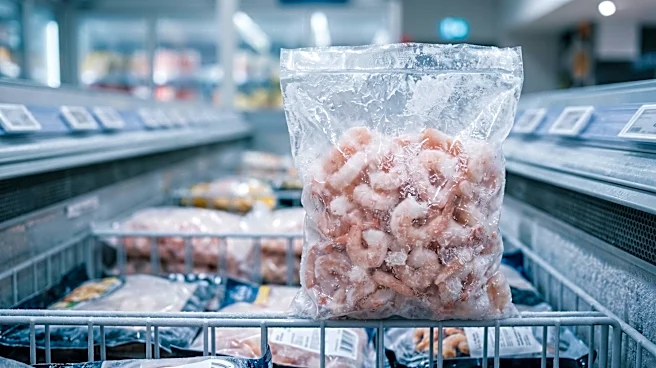
for both single-ingredient products and seafood components in multi-ingredient foods, such as frozen shrimp scampi. The FDA's initiative acknowledges that seafood products differ from USDA-regulated items, making it challenging to establish the origin of certain wild-caught fish. The draft guidance ties 'U.S.-caught' claims to the federal fisheries management framework, including the U.S. exclusive economic zone (EEZ). It provides examples of acceptable statements like 'U.S.-Caught,' 'U.S. Farm-Raised,' 'Processed in the United States,' and 'USA Seafood,' along with recommendations for substantiating these claims with records. The FDA is accepting public comments on this draft guidance until December 28, 2026.
Why It's Important?
This draft guidance is significant for U.S. seafood manufacturers, packers, and distributors as it provides a clearer framework for labeling seafood products with U.S. origin claims. By defining terms like 'U.S.-Caught' and 'U.S. Farm-Raised,' the FDA aims to enhance transparency and prevent misleading labeling practices in the seafood industry. This clarity can help consumers make more informed purchasing decisions, potentially boosting demand for domestically sourced seafood. Companies that can substantiate their U.S. origin claims stand to gain a competitive advantage, while those that fail to comply may face regulatory scrutiny. The guidance also highlights the FDA's recognition of the unique challenges in tracing seafood origins compared to other agricultural products, indicating a tailored approach to regulation in this sector.
What's Next?
The FDA will continue to accept comments on the draft guidance until December 28, 2026. Following this period, the agency will review the feedback and finalize the guidance. Once finalized, this document will serve as the FDA's current thinking and evaluation criteria for U.S.-origin claims on seafood. Seafood companies will need to review their labeling practices to ensure compliance with the finalized guidance. This may involve updating product labels, strengthening record-keeping systems to substantiate claims, and potentially adjusting sourcing strategies to align with the new definitions of U.S. origin. The industry will likely see increased scrutiny on origin claims, pushing for greater traceability and transparency throughout the seafood supply chain.
Beyond the Headlines
The FDA's draft guidance on U.S. origin statements for seafood has broader implications beyond mere labeling compliance. It underscores a growing consumer demand for transparency regarding food origins and sustainable sourcing. This move could encourage more domestic seafood production and processing, potentially creating jobs and strengthening the U.S. seafood industry. Ethically, it addresses concerns about misrepresentation and supports fair competition. Legally, it sets a precedent for how origin claims are defined and enforced in a complex global supply chain. Culturally, it taps into a preference for local and national products, potentially influencing consumer purchasing habits and fostering a stronger connection between consumers and the source of their food.