
What's Happening?
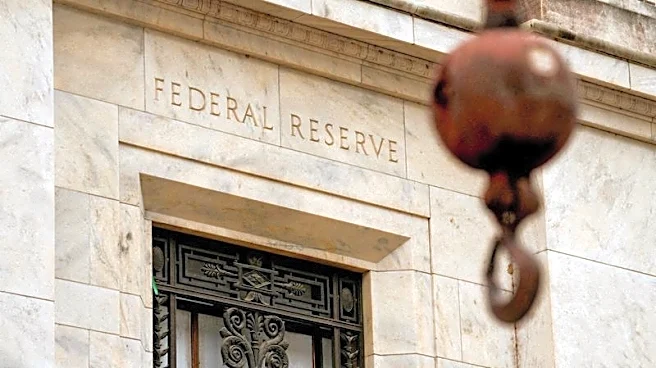
Kansas City Fed President Jeffrey Schmid has indicated that current inflation levels are not aligning with the Federal Reserve’s targets, suggesting that additional monetary policy actions may be necessary. Schmid's remarks underscore ongoing concerns
within the Federal Reserve regarding inflation, which remains above the central bank's 2% target. While he did not explicitly call for an immediate rate hike, his comments align with a broader sentiment of continued vigilance from the Federal Reserve in managing inflationary pressures. Recent economic data supports the view that inflation has not yet subsided to the desired levels, prompting discussions among Fed officials about the appropriate path forward for monetary policy. Market participants are closely monitoring these statements, with current pricing in prediction markets suggesting an 87.5% probability of at least one rate hike in 2026.
Why It's Important?
These statements from a Federal Reserve official are significant because they signal a potential shift towards a more hawkish monetary policy stance, which could have substantial implications for the U.S. economy. If the Federal Reserve proceeds with further rate hikes, it would increase borrowing costs for businesses and consumers, potentially slowing economic growth. Industries reliant on consumer spending or significant capital investment, such as housing and manufacturing, could face headwinds. For consumers, higher interest rates would translate to more expensive mortgages, car loans, and credit card debt. The Federal Reserve's primary challenge is to balance controlling inflation without triggering a significant economic downturn. The market's anticipation of future rate hikes, as indicated by prediction markets, suggests that investors are already factoring in the possibility of tighter monetary conditions, which can influence asset prices and investment decisions.
What's Next?
The financial markets and economic observers will be closely watching for future statements from other Federal Reserve officials, particularly from Chair Jerome Powell, for further clarity on the likelihood and timing of potential rate hikes. Upcoming economic indicators, including inflation reports and employment data, will be critical in shaping the Federal Reserve's policy decisions. Strong inflation data could reinforce the need for rate hikes, while signs of economic slowdown might prompt a more cautious approach. Any changes in the Federal Reserve's official language, projections, or dot plot will significantly influence market expectations regarding interest rates in 2026. Businesses and consumers should prepare for the possibility of a continued environment of higher interest rates, which could impact financial planning and investment strategies.
Beyond the Headlines
The ongoing debate within the Federal Reserve about inflation and interest rates highlights a fundamental tension in modern monetary policy: how to effectively manage price stability without stifling economic growth. The current situation reflects the complexities of post-pandemic economic recovery, where supply chain disruptions, geopolitical events, and shifting consumer demand continue to exert inflationary pressures. The Federal Reserve's decisions have broader implications for global financial markets, as U.S. interest rate policy often influences capital flows and currency valuations worldwide. The challenge extends beyond mere economic metrics, touching upon the credibility of central banks and their ability to guide economies through periods of uncertainty while maintaining public trust in their independence and effectiveness.