









What's Happening?
Venus Aerospace has successfully raised $91 million in a Series B funding round to enhance the development and production of its rotating detonation rocket engine (RDRE). This funding round was led by Mercury Fund and included significant contributions
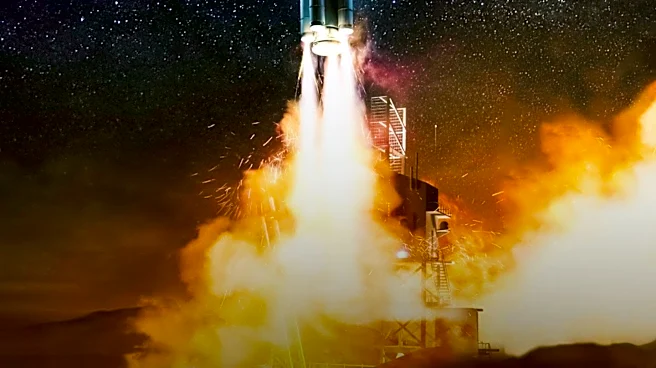
from Lockheed Martin Ventures, MESH, PEAK6, Draper Associates, and others. The RDRE technology, which Venus Aerospace has been pioneering, offers a more efficient alternative to conventional rocket engines. The company made headlines in May 2025 by becoming the first U.S. entity to complete a successful test flight of an RDRE-powered rocket. This achievement has spurred increased interest from various sectors, including the Department of Defense (DoD) and commercial space applications. The new capital will be used to expand Venus Aerospace's team, increase production capabilities, and conduct further demonstration flights.
Why It's Important?
The advancement of RDRE technology by Venus Aerospace represents a significant leap in rocket engine efficiency and versatility. The RDRE is reported to be 15% more efficient than traditional rocket engines, which could lead to substantial cost savings and performance improvements in both military and commercial space missions. The ability to use liquid propellants like JP-10 and hydrogen peroxide allows for more efficient thrust control and longer storage life, making it a viable option for long-duration space missions. This development could potentially disrupt the current market for solid-rocket motors and in-space propulsion systems, offering a more adaptable and efficient solution. The successful scaling of RDRE production could position Venus Aerospace as a key player in the aerospace industry, with implications for national defense and space exploration capabilities.
What's Next?
Venus Aerospace plans to leverage the new funding to secure major contracts in both the defense and space sectors. The company aims to establish a low-rate production of RDRE units, targeting one major weapons contract and one major space contract. This strategy is intended to demonstrate the engine's dual-use capabilities and pave the way for scaling production to meet higher demand. The company is focused on increasing its production capacity to potentially produce thousands of units annually, which would require further investment and expansion. The success of these efforts could lead to broader adoption of RDRE technology across various applications, enhancing the U.S.'s competitive edge in aerospace technology.