






What's Happening?
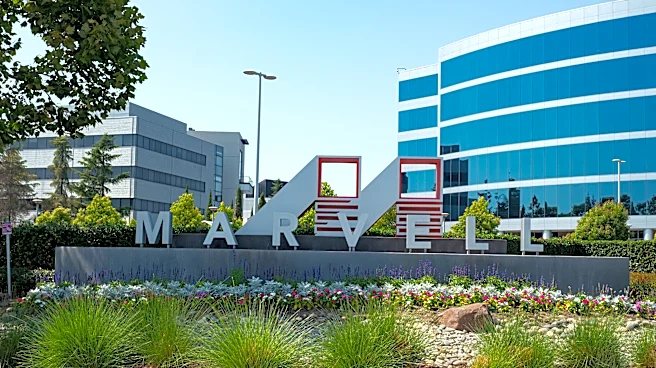
Marvell Technology, Inc. (MRVL) stock experienced a significant decline of 9.41%, trading at $119.19 midday Wednesday after closing at $131.57 on Tuesday. This downturn is primarily attributed to a sector-wide repricing within the semiconductor industry,
rather than a specific company-related fundamental shock. The broader market saw a de-risking of high-multiple AI hardware names following a hotter-than-expected October core PCE reading of 3.3%, which increased the probability of a December Federal Reserve rate hike. Additionally, two recent analyst target cuts for Marvell Technology, from Oppenheimer and Susquehanna, contributed to pre-earnings caution. The Philadelphia Semiconductor Index dropped over 7%, and other major semiconductor companies like Nvidia, AMD, and Broadcom also saw sharp declines. Marvell is set to report its fiscal third-quarter results on December 1, with analysts expecting $1.10 in non-GAAP EPS on approximately $3.16 billion in revenue.
Why It's Important?
The decline in Marvell Technology's stock, alongside a broader semiconductor sector downturn, highlights the sensitivity of high-growth technology companies to macroeconomic indicators and monetary policy expectations. The increased likelihood of a Federal Reserve rate hike, driven by inflation data, directly impacts the valuation of equities, particularly those with longer duration like AI semiconductor suppliers. This sector-wide repricing indicates a shift in market sentiment, where investors are re-evaluating the multiples deserved by AI demand. The analyst target cuts, even if modest, signal a more cautious outlook on valuation, which can influence investor confidence and trading activity. For the U.S. technology sector, this trend suggests that even companies with strong long-term growth prospects, such as Marvell's fiscal 2028 revenue target of $20 billion, are not immune to immediate market pressures stemming from inflation concerns and potential interest rate adjustments. The performance of companies like Marvell is a bellwether for the health of the data infrastructure and AI markets.
What's Next?
Investors will closely monitor Marvell Technology's fiscal third-quarter results, scheduled for release after the market closes on December 1. Key areas of focus will include data-center growth, guidance for the January quarter, and trends in gross margin as custom silicon mix increases. Management's reaffirmation of its fiscal 2028 outlook will also be critical. Beyond the earnings report, the upcoming December Federal Reserve meeting, commentary on hyperscaler capital spending, and any regulatory updates regarding the Lumentum transaction are significant swing factors. The market will also be watching whether the November 20 low near $120.56 holds as support for the stock. Risks include further multiple compression, customer concentration, potential supply constraints, and the impact of $1 billion in capacity prepayments. The outcome of these events will likely dictate the near-term trajectory for Marvell Technology and potentially influence the broader semiconductor market.
Beyond the Headlines
The current market dynamics affecting Marvell Technology and the semiconductor industry reveal a deeper re-evaluation of the 'AI trade' and its valuation. While the underlying demand for AI infrastructure remains strong, as evidenced by Marvell's accelerating data-center demand commentary, the market's debate has shifted from the existence of AI demand to the appropriate valuation multiples. This recalibration reflects a broader investor caution in a rising interest rate environment, where future earnings are discounted more heavily. The contagion effect from Analog Devices' soft outlook, which indiscriminately impacted the chip complex, underscores how interconnected the semiconductor industry is and how a single company's guidance can trigger sector-wide selling. This highlights the challenge for investors in distinguishing between company-specific issues and broader market trends, especially in a volatile sector driven by both technological innovation and macroeconomic forces. The ongoing Lumentum acquisition also introduces an element of uncertainty regarding dilution and financial metrics, adding another layer of complexity to Marvell's investment profile.