






What's Happening?
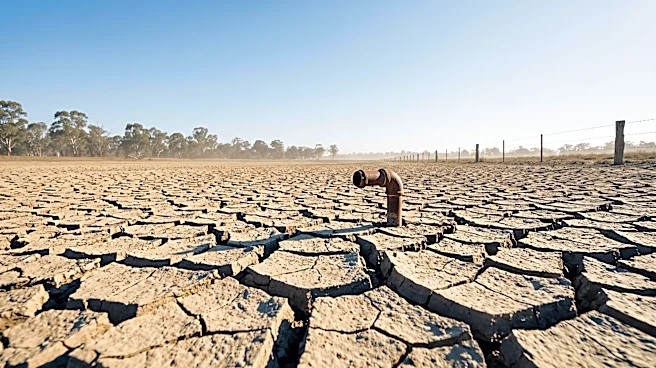
A new report by agri-data company Digital Agriculture Services (DAS) indicates that drought risk is significantly mispriced in the Australian insurance market, potentially costing the country up to $12 billion in lost economic output in a single season.
The report, titled 'The $12 Billion Risk Insurers Aren’t Pricing,' highlights a critical gap: while other natural perils like flood, fire, cyclone, and storm have established risk models, drought does not. This absence of property-level data for drought risk is impacting how farm portfolios are constructed, priced, and retained by insurers. In 2025, over 233,000 agricultural parcels in Australia experienced drought or drought stress conditions. Projections suggest that under a moderate emissions scenario, 32,179 rural properties will face persistent drought stress by 2030, rising to 89,538 by 2050.
Why It's Important?
The mispricing of drought risk has profound implications for Australia's agricultural sector and broader economy. Without accurate property-level data, insurers are unable to adequately assess and price the risk, leading to higher premiums across the board or even insurers exiting certain regions. This exacerbates the insurance protection gap, particularly in rural areas, where the Australian Prudential Regulation Authority (APRA) projects that uninsured households could exceed 40% by 2050. The financial stress on farm businesses due to drought, coupled with inadequate insurance coverage, can lead to significant economic losses and reduced agricultural output. Furthermore, drought acts as a multiplier for other perils, such as bushfires, as evidenced by the $1.866 billion in insured losses from the Black Summer fires that followed severe drought. This situation threatens the long-term viability of farming operations and the stability of the rural economy.
What's Next?
The DAS report calls for a fundamental shift in how drought risk is understood and priced within the insurance industry. The immediate next step involves developing property-level data and risk models specifically for drought, similar to those for other natural disasters. This will require collaboration between agri-data companies, insurers, and potentially government bodies to collect and analyze granular data. Insurers may need to innovate their product offerings to include drought coverage or develop more sophisticated parametric insurance solutions. Without these changes, the trend of rising premiums, reduced coverage, and increased financial vulnerability for Australian farmers is likely to continue. The report's findings could also prompt regulatory discussions on climate risk disclosure and the role of insurance in building agricultural resilience against climate change.
Beyond the Headlines
The issue of drought mispricing extends beyond mere financial calculations, touching upon the broader societal challenge of adapting to climate change. The lack of adequate insurance for drought reflects a systemic underestimation of climate-related risks in traditional financial models. This situation highlights the need for a more holistic approach that integrates climate science, agricultural economics, and insurance innovation. Ethically, it raises questions about the responsibility of the financial sector to support vulnerable industries in the face of escalating environmental threats. Culturally, the resilience of Australia's farming communities, deeply tied to the land, is at stake. The long-term implications could include significant shifts in agricultural practices, land use, and rural demographics as farmers grapple with increasingly unpredictable and uninsurable conditions, potentially leading to a re-evaluation of national food security strategies.