

What's Happening?
The artificial intelligence (AI) video generation market is rapidly evolving, moving beyond basic social media graphics to offer sophisticated tools for professional production workflows. While platforms like Grok Imagine are suitable for quick social content,
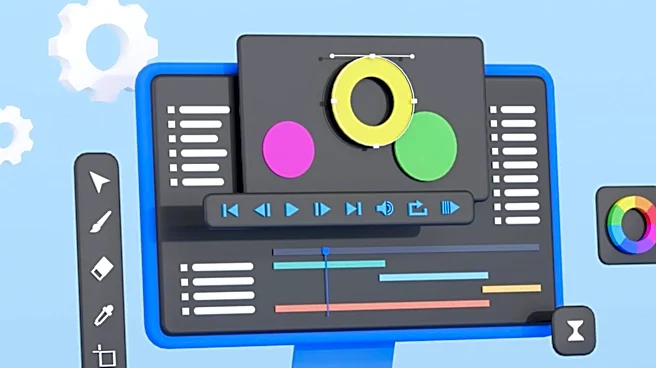
the industry now provides alternatives designed for complex tasks such as product launch films, multi-market campaign variants, and footage requiring professional color grading. This shift indicates a growing adoption of AI tools by creative teams for more demanding production needs. Companies are developing platforms with features like native HDR output, 4K resolution, integrated editing, and character consistency across clips. The focus is on providing solutions that fit into existing professional post-production pipelines, allowing for seamless integration with tools used by colorists and editors.
Why It's Important?
This expansion of AI video generation tools signifies a significant transformation in the media production landscape. For U.S. industries, particularly advertising agencies, film studios, and marketing departments, these advancements offer opportunities for increased efficiency and cost savings. The ability to generate high-quality, production-ready footage with AI can streamline workflows, reduce the need for extensive traditional filming, and accelerate content creation cycles. This could lead to faster campaign launches and more agile responses to market demands. However, it also poses challenges, as creative professionals will need to adapt to new technologies and integrate AI into their skill sets. Companies that embrace these tools early could gain a competitive advantage, while those that lag may find themselves at a disadvantage in a rapidly evolving market. The development of specialized tools for different production needs, from high-volume automated content to precision-edited films, highlights the growing maturity and diversification of the AI video generation sector.
What's Next?
The AI video generation market is expected to continue its rapid growth and diversification. Future developments will likely focus on enhancing the realism and creative control offered by these tools, potentially including more advanced keyframe controls, improved character and product consistency, and higher resolution outputs. Integration with existing professional software ecosystems, such as Adobe Creative Cloud, will also become more seamless, further embedding AI into standard production workflows. As more creative teams adopt these technologies, there will be an increased demand for training and education to equip professionals with the necessary skills. The competition among AI video generation platforms will intensify, driving further innovation and specialization to meet the diverse needs of the production industry. The question for many creative teams will shift from whether to use AI to which specific platform best aligns with their unique production requirements and existing workflows.
Beyond the Headlines
The rise of advanced AI video generation tools carries broader implications beyond immediate production efficiencies. Ethically, the increasing sophistication of AI-generated content raises questions about authenticity and the potential for misuse, such as the creation of deepfakes or misleading narratives. Legally, issues surrounding copyright for AI-generated content and the ownership of intellectual property will become more prominent, requiring new frameworks and regulations. Culturally, these tools could democratize video production, allowing smaller creators and independent studios to produce high-quality content previously only accessible to larger organizations. This could lead to a more diverse and dynamic media landscape. However, it also prompts a re-evaluation of traditional creative roles and the value of human artistry in an era where machines can generate compelling visual narratives. The long-term shift could see a hybrid model where human creativity is augmented and amplified by AI, rather than replaced, leading to entirely new forms of artistic expression and production methodologies.